
 IB Docs (2) Team

2. Gulf War: short-term causes
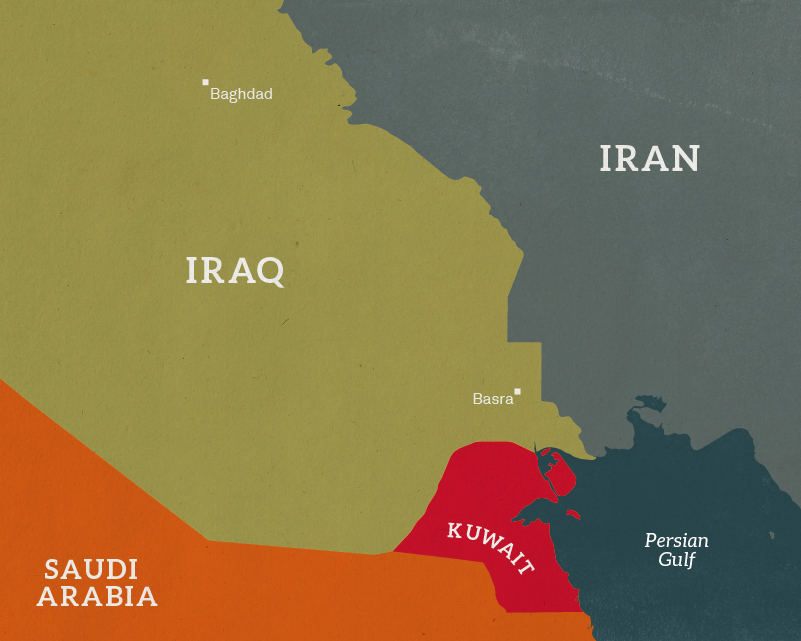
By 1990, tensions were growing between the West and Saddam, but also between Iraq and Kuwait. When Saddam invaded Kuwait in August 1990, he miscalculated on the response of the international community and Desert Storm started on 16 January 1991.
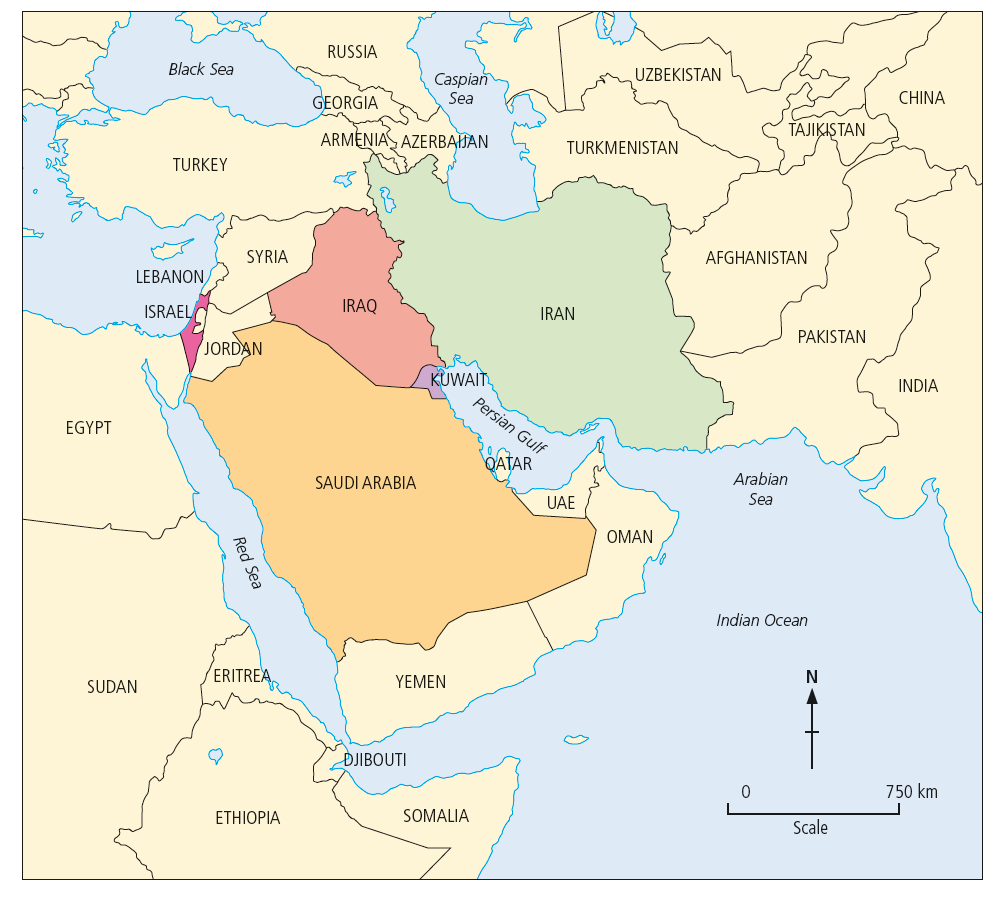
What factors led to coalition against Iraq and outbreak of war?
From 1989, a series of events came together to result in the start of the Gulf War:
Western hopes of Iraq moving to a more moderate stance evaporated in 1990 when Saddam made a series of ruthless moves. There was already a growing concern in the West over Iraq’s human rights record and also over the vast amounts of money that Iraq was spending on weapon systems. In March 1990 Farzad Bazoft, a journalist working for the British newspaper The Observer, was executed in Iraq on trumped-up charges of spying. British intelligence also intercepted items of technology from the West that appeared to be necessary for long-range missiles and weapons of mass destruction (WMD). These events now put pressure on the Western countries to halt arms sales. In April, meanwhile, Saddam made a threat to use chemical weapons against Israel. He also gave more financial aid to sustain the Intifada and, at an Arab summit meeting in Baghdad, claimed that the enemy of the Arab camp was now ‘Greater Israel’.
At the same time as the events described above, the relationship between Iraq and Kuwait was deteriorating fast. Some disagreements between the two countries went back a long way:
• There was a long-standing argument over the frontiers between the two countries. In the 1930s, the new state of Iraq had claimed that Kuwait, formerly a British protectorate, belonged to Iraq. It also laid claim to the islands of Bubijan and Warbah at the head of the Persian Gulf.
• There was unresolved disagreement over the right to exploit the Rumaila oilfield on the Iraq–Kuwait border.
However, as explained on the previous page the real issue for Iraq in 1990 was its economic crisis, and in 1990, Iraq put increasing pressure on Kuwait to help it solve this crisis:
• At a summit meeting in Amman in February 1990, Saddam asked King Hussein of Jordan and President Mubarak of Egypt to inform Kuwait that Iraq not only wanted cancellation of wartime loans, but that he also needed additional funds of some $30 billion. Both requests were refused.
• Iraq also requested that Kuwait keep to OPEC quotas for oil output. More oil on the international market meant lower prices per barrel and thus less income for Iraq. Kuwait was the chief culprit in overproduction in a deliberate strategy to drive down the price of oil, so that more nations became dependent on OPEC oil. The long-term benefits of such a strategy were of no help to Saddam Hussein who, facing increasing political unrest at home, needed money immediately.
In July 1990, the dispute with Kuwait became much more intense. Saddam Hussein started making accusations against Kuwait; that it had stolen more than $2 billion of oil from the Rumaila oilfield, which Iraq claimed as its own, and that the loans that Iraq had received during the Iran–Iraq War came from profits due to overproduction (see above). He said that Kuwait’s unwillingness to cancel Iraq’s war debts constituted ‘military aggression’ and that Kuwait was ‘stabbing Iraq in the back with a poisoned dagger’. At the same time, Saddam backed up his verbal attacks on Kuwait with a military threat; large numbers of the elite Republican Guard divisions were moved towards the border with Kuwait.
Efforts were made to resolve the crisis peacefully:
• 27 July – OPEC put up the official oil price from $18 to $21 a barrel as requested by Iraq.
• After much persuasion by the Egyptian and Jordanian leaders, an Iraqi delegation led by Izzat Ibrahim (Saddam’s deputy) met Kuwaiti representatives in Saudi Arabia on 31 July. However, little progress was made and the meeting was abandoned by Iraq, who claimed that Kuwait was acting ‘against Iraq’s basic interests’.
There was also a meeting between Saddam and the US ambassador to Iraq, April Glaspie. Rather than deterring Saddam from invading Iraq, it seems that Glaspie’s conversation with Saddam gave the impression that the USA would take no action. She stated that ‘We have no opinion on the Arab–Arab conflicts, like your border disagreement with Kuwait’, although she did make it clear that differences should be solved by peaceful means. Saddam also received no warning from the USA, despite the fact that the Pentagon had detected Iraqi military divisions close to the Kuwaiti border.
Certainly Saddam Hussein seems to have believed that the world would not act against him when, on 2 August, he launched the Iraqi invasion of Kuwait with more than 100,000 soldiers and almost 2,000 tanks. Within 12 hours of the invasion, the bulk of the resistance had been extinguished and the Kuwaiti royal family had fled to Saudi Arabia. On 28 August, Kuwait was declared to be the 19th province of Iraq.
Task One
ATL: Thinking skills
Discuss in pairs or as a class the following:
1. How would the invasion of Kuwait solve the problems that you identified in the review questions on the previous page?
2 What reasons would Saddam Hussein have had for believing that the USA would not take any action against him?
Info box on Kuwait:
The sheikdom of Kuwait, as you can see from the map above is much smaller than its neighbours. Its small population (two million before the invasion, of which fewer than a million were Kuwaitis), however, and its large oil resources meant that it was extremely rich. Its GNP was more than $26 billion in 1989. Kuwaiti City had become a capital city of great wealth and there were good health and education services. Yet there were also big divisions in society. The thousand or so members of the ruling al-Sabah family effectively ruled the country. In 1986 the Emir had disbanded the Kuwaiti parliament and in 1989 he rejected pleas to reinstate it. The bulk of Kuwaiti citizens themselves were divided into first- and second-class citizens. Half of the emirate’s population were immigrants without citizenship or full civic rights. Nomadic Bedouin were denied rights because they could not prove fixed residence, as too were Palestinians and others, even if born in Kuwait.
Task Two
ATL: Thinking skills
Read the sources below. What factors are identified as the reasons for Saddam's invasion?
Source A
The invasion of Kuwait promised a cure to both the economic and military legacy of the Iran–Iraq war. Kuwait’s oil wealth would enable the Iraqi regime to reconstruct the state and to pay its non- Arab creditors. It would keep the army busy and far away from the capital. The claims of victory over Iran would be replaced with a real victory for Kuwait. The invasion was also seen as way to project Iraqi hegemony not just over Kuwait but also over the Gulf as a whole. This would allow Iraq to dictate oil prices and quotas to serve its own interests, as it would control 21 per cent of OPEC’s total production. And, ultimately, the extension of military and economic power would enable Iraq to claim the mantle of pan-Arab leadership as the region’s most powerful country, especially as it was the only country which had never even signed so much as an armistice with Israel and the only Arab state left to embrace the PLO wholeheartedly.
From Antony Best et al., International History of the Twentieth Century, 2004
Source B
The invasion of Kuwait might have been averted. The 1979 Pentagon study had advised that the military needed to flex its muscles early in a crisis to deter an Iraqi invasion. But the administration never acted on that recommendation. It had not been so much a failure of intelligence as a failure to act on available information. An elementary lesson of deterrence had been lost. The Bush administration drew a line in the sand in firm, deep strokes, but not until the Iraqis had already crossed it.
Gordon and Trainor, The General’s War, Atlantic Books, 1995, pg 29
Task Three
ATL: Thinking skills
What can you learn from the graph below about the reasons for Saddam's invasion of Kuwait and also for why the West would be concerned by the invasion?
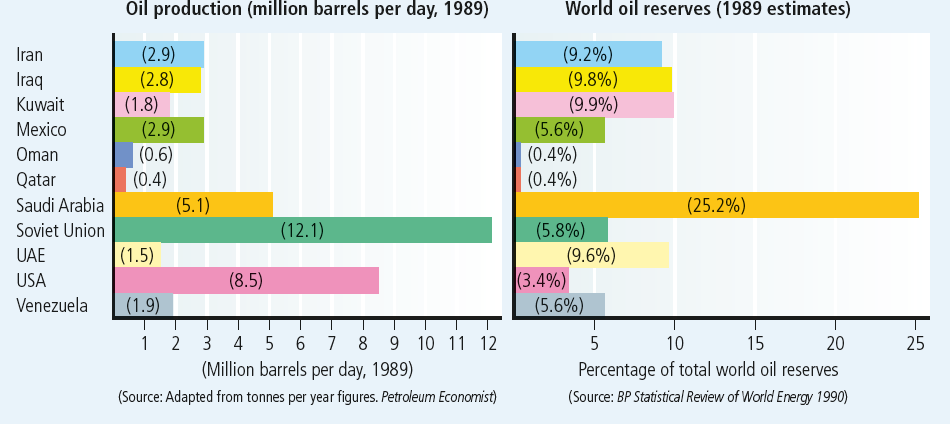
Saddam Hussein had miscalculated first on the USA’s reaction to the invasion. Not only was this an act of aggression by one UN country against another, but the appropriation of Kuwait’s oilfields meant that Iraq would now have an unacceptable level of influence in OPEC and the pricing of oil worldwide. There was also now the possibility of an attack on Saudi Arabia, which would place virtually all Arab oil under Iraq’s control (see graph above) and cause economic and political instability in the region. As the USA relied on imports for about 50 per cent of its oil requirements, it could not afford to let one country, especially one with a leader such as Saddam Hussein, have such control. American allies in the West were also highly alarmed and ready to join the USA in confronting the Iraqi regime. Given the new international context with the ending of the Cold War, Saddam could not even rely on support from the USSR.
Saddam also badly miscalculated on the effect the invasion would have on Arab states. Many had believed that Saddam was only bluffing. The outrage that was felt by Arab states at the deception, and at the fact that one Arab state had invaded another, with all of the implications that this had for regional stability, set the stage for a coalition with the West.
The UN Security Council quickly established a comprehensive set of sanctions against Iraq. These were supported by the Soviet Union, a clear indication of the new international order that was now emerging. Meanwhile, the USA had managed to persuade King Fahd of Saudi Arabia of the need for a US force in his country in order to protect Saudi Arabia from invasion. From 8 August, US troops started arriving in his country as part of Operation Desert Shield. Two days later, the Arab League passed a motion condemning Iraq’s occupation of Kuwait and authorizing the dispatch of Arab forces to Saudi Arabia to join those of the USA.
It was hoped by many that negotiation combined with sanctions would achieve a solution to the crisis that would avoid war. Saddam did suggest on 12 August a peace plan that involved the USA leaving Saudi Arabia, Syrian troops leaving Lebanon and Israel withdrawing from the Occupied Territories. Yet his attempt to link the wider Palestinian issue with the invasion of Kuwait was highly problematic, and was more an attempt to play for time in the hope that the coalition would become divided and weakened.
Freedman and Karsh write that:
Saddam never himself acted as if a diplomatic solution based on a combination of withdrawal from Kuwait and a face-saver was readily available. He did not engage in an active search for an escape route. His response to the various formulas offered by anxious third parties and regional allies was generally dismissive. At no time did he ever spell out his conditions for withdrawal, other than to suggest that once all other problems in the Middle East had been dealt with the question of Iraq’s new nineteenth province might also be addressed.
From L. Freedman and E. Karsh, The Gulf Conflict, 1990–1991, 1995
Thus, although several attempts at mediation were made, Saddam’s determined intransigence on the issue of withdrawal from Kuwait made a peaceful solution increasingly unlikely. Meanwhile, international opinion was also hardened against Saddam by reports of Iraqi brutality in Kuwait and by Saddam’s plans to use civilian hostages trapped in his country as human shields.
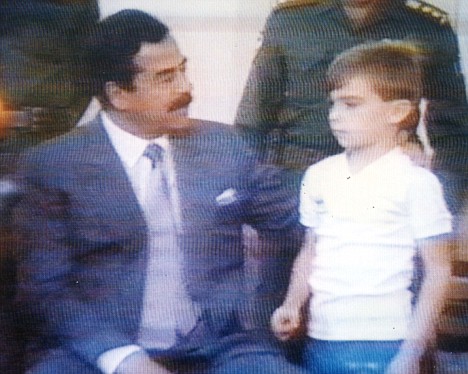 Saddam Hussain announced that citizens from any country threatening Iraq would have to stay in Iraq until the threats ended. One of the hostages, a five-year old British boy, Stuart Lockwood, was forced to pose with Saddam Hussein in a television broadcast which caused much unease and consternation in the west.
Although many in Bush’s administration wanted to give sanctions more time to work, ultimately Bush could not allow this to happen. There was no guarantee that they would have enough impact on Saddam himself to get him to back down, and in any case the USA did not have the time to wait and see if this would happen. It had to keep the coalition together and keep the political and military pressure on Saddam, and this situation could not be maintained indefinitely. Nevertheless, sanctions did play an important role by giving a focal point for international unity before armed conflict, and imposing economic hardship on Iraq:
…an international coalition could be forged around them in a way that would not have been possible in a rush to armed force, and this was also the means by which the United Nations was drawn into its central role. Five months of the embargo undermined the ability of Iraq to sustain a long war.
From L. Freedman and E. Karsh, The Gulf Conflict, 1990–1991, 1995
Task Three
ATL: Thinking skills
Study the two extracts from Freedman and Karsh above.
What do they suggest were: a) Saddam’s attitude to a diplomatic solution to the crisis; b) the importance of economic sanctions in the months before the war started?
As you have read above, Saddam seems to have underestimated the reaction of the world when he invaded Kuwait. Once troops started arriving in the region (by 15 January 1991, the Allied forces had reached a figure of 555,000 men and women) ,it was believed that Saddam, having failed to respond to economic sanctions or to negotiations, would see the impossibility of taking on the might of the American war machine. Yet Saddam was overconfident, after the war with Iran, in his ability for survival. It is also possible that he believed right up to January 1991 that the Americans would not actually risk a war, and that the peace movement would grow in voice and undermine the solidarity of the coalition. He thus ended up miscalculating yet again on American actions.
On 29 November 1990, the UN Security Council had approved another resolution (its 12th of the crisis) authorizing the use, after 15 January 1991, of any necessary measures to secure the removal of Iraq from Kuwait and the restoration of its former rulers. This resolution provided the legitimate grounds for war and it was passed by 12 votes to two (Yemen and Cuba voting against and China abstaining).
Operation Desert Shield now became Operation Desert Storm, which had the objective of militarily pushing Saddam’s forces out of Kuwait. Last-minute mediation attempts all failed, and Desert Storm started on 16 January 1991.
Task Four
ATL: Thinking and self-mangement skills
For each of the following headings, write notes to explain the significance of each factor in contributing to the build-up of tensions and the eventual outbreak of war.
Long-term causes of the war
• Iran–Iraq War
• Decline of Soviet Influence
• Saddam’s attempt to expand his influence in the region
• Western support for Saddam.
Short-term causes (events in 1990)
• Iraq’s economic position by 1990
• US failure to give stronger signals concerning Saddam’s actions
• Saddam’s invasion of Kuwait.
Triggers for war
• Limited impact of sanctions
• Failure of negotiations
• The US need to keep the coalition together
• Saddam’s miscalculations.
Task Five
ATL: Thinking skills
Some sections of public opinion in the West believed that the actions of the US with regard to Kuwait, and its mobilisation of the UN to take action, were caused by the issue of oil; and that indeed Saddam would probably have got away with the invasion had Kuwait not had oil. The slogan 'blood for oil' became a common cry for protesters against the war.
Organise a class debate around the following motion:
‘This House believes that the Gulf conflict was a simple case of ”blood for oil’’
Divide the class into two teams. Each team should have three speakers. The rest of the team should also help in researching and writing the speeches.
 Twitter
 Facebook
 LinkedIn