
 IB Docs (2) Team

5. The US Occupation 1945 to 1952
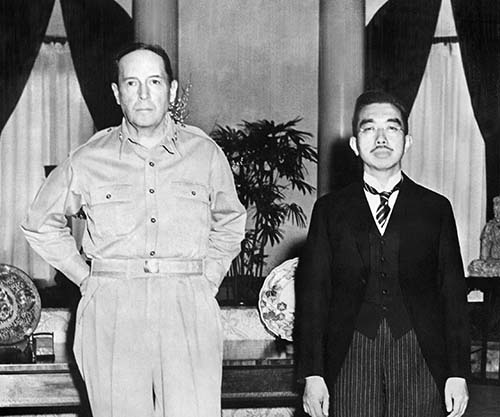 The occupation of Japan by the US from 1945 to 1952 was led by General Douglas MacArthur, the Supreme Commander of the Allied Powers, with support from the British Commonwealth; unlike Germany, the Soviet Union was allowed no part of this occupation. The occupation brought about widespread military, political, economic and social reforms to Japan.
Guiding questions:
What was the situation in Japan at the end of the war?
What was SCAP? What initial policies were implemented in Japan?
How was the occupation organized and the policy of demilitarization implemented?
How was the policy of democratization implemented in post-war Japan?
What economic reforms were implemented during the occupation?
What social reforms were implemented and what was the cultural impact of the US occupation?
To what extent was Japan changed by the US Occupation?
What are the views of historians on the impact of the US occupation?
To what extent did SCAP achieve the objectives outlined in 1945?
1. What was the situation in Japan at the end of the war?
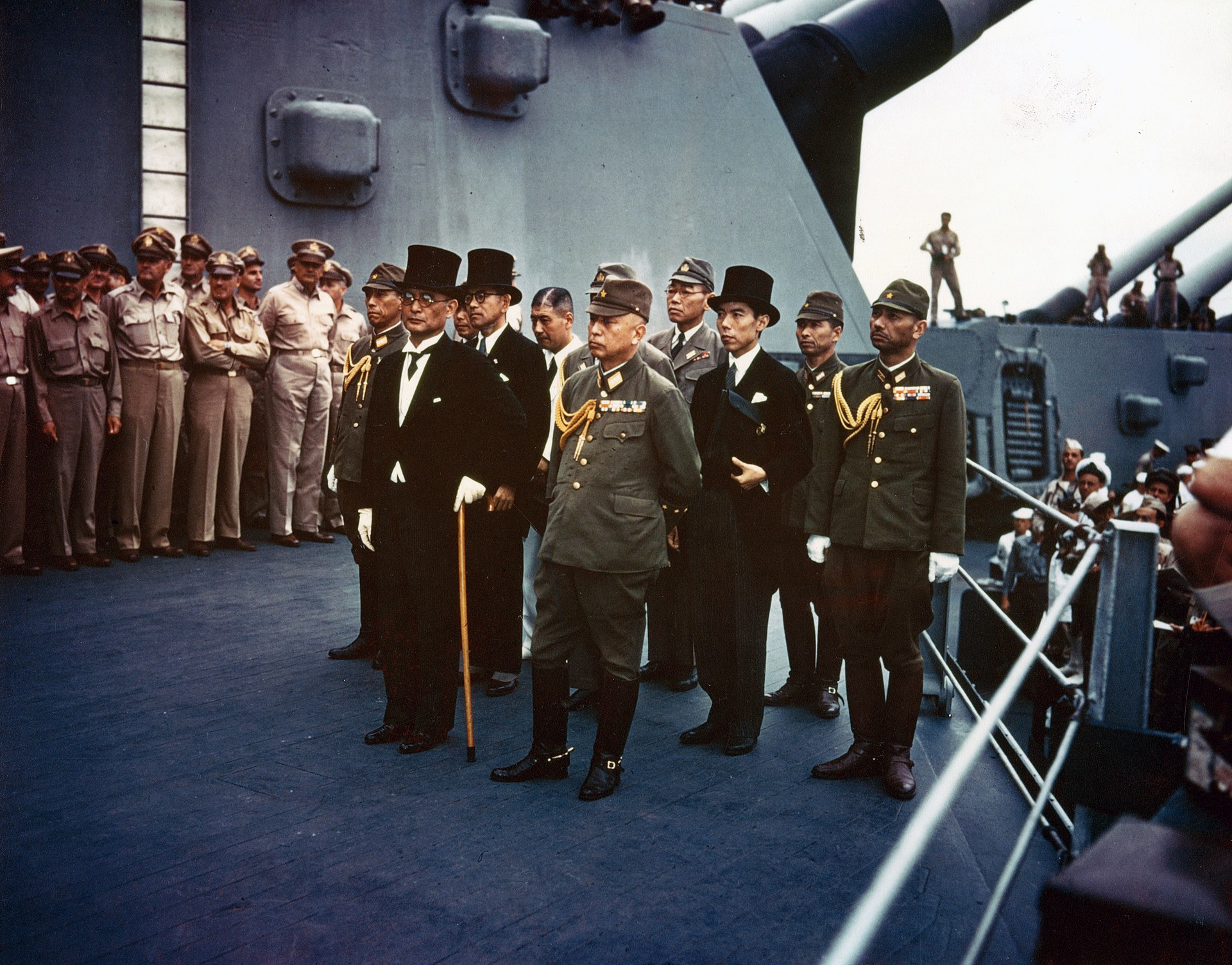 The Japanese government surrendered on 14th August 1945 when its government informed the Allies that it accepted the Potsdam Declaration. On 19th August Japanese officials headed to Manila to meet General MacArthur to be briefed on US plans for the post-war occupation. MacArthur arrived in Tokyo on 30th August and declared a series of laws for his occupying forces which forbade any allied personnel from assaulting the Japanese people or taking food from the starving population. The occupation, code named Operation Blacklist lasted until April 1952.
Representatives of the Empire of Japan stand aboard the USS Missouri prior to signing of the Instrument of Surrender.
Task One
ATL: Thinking skills
This documentary, Japan under American occupation has disappeared from Youtube at the moment - if anyone finds it again, please let us know! Thanks
- What was the nature of fighting between the US and Japan in the final year of the Second World War?
- How many US troops were initially sent to occupy Japan?
- What shocked US troops when they liberated Japanese POW camps?
- What sentiments did the US troops have towards the Japanese people?
- Describe the scale of the effects of the war on Japanese society – human cost, housing and infrastructure.
- Why was McGovern’s film documenting the impact of the war on the Japanese people ‘never made’?
- What was meant by an ‘affliction of the spirit’?
- How many children were a] orphaned b] separated from their parents at the end of the war?
- What evidence was there of widespread starvation?
Task Two
ATL: Thinking and self-management skills
In pairs read through the material below and using your knowledge and understanding of Japanese policies in the 1930s and Japan’s aims and experience of the Second World War, discuss the issues the US occupation might have in achieving its key objectives.
On 2nd September Japan signed the formal surrender, the Japanese Instrument of Surrender. Then, on 6th September, US President Truman approved the US Initial Post-Surrender Policy for Japan which set down two main aims for the occupation:
I] Eliminating Japan’s potential to make war
II] Turning Japan into a democratic nation which supported the UN
Japan had not been a western-style democracy before 1945, although there had been similarities in the 1920s. Japan had then moved away from liberal democracy in the 1930s. As outlined in the post-surrender policy, the US occupation aimed to democratize Japan by drafting a democratic constitution and purging politicians that were associated with militarism prior to the war. It was believed that via a range of reforms encompassing education and culture, democratic values could be instilled in Japan.
2. What was SCAP? What initial policies were implemented in Japan?
President Truman appointed General Douglas MacArthur as Supreme Commander for the Allied Powers (SCAP) to oversee the occupation of Japan. During the war the plan had been to share the occupation between the Allied powers as had been implemented in post-war Germany. However, the final plan gave SCAP control of the main islands of Japan. The wartime plan for Japan may have changed for a number of reasons; firstly, the increase of US power after it gained the A bomb; secondly President Truman distrusted the USSR more than his predecessor Roosevelt, and finally there was an intention to contain Soviet influence in East Asia after the Yalta Conference.
The Soviet Union had forces stationed in North Korea, South Sakhalin and Kuril Islands and the US had troops in South Korea, Okinawa, Amami Islands, Ogasawara and on the Japanese possessions in Mirconesia. The Chinese government had control of Taiwan and Penghu.
Task One
ATL: Thinking skills
Continue watching the documentary Japan under American occupation from 11.41 until 15.06 and answer the following questions:
- What did General MacArthur say about the power he had been given in post-war Japan?
- What was SCAP’s first major crisis?
- What was vital for a military government to establish in the first phase of an occupation?
- What proposal did the US Congress initially reject?
- Where did SCAP initially source food for the starving Japanese population from?
- What was outlined in the ‘orientation film’ MacArthur ordered all his troops to watch on arrival in Japan?
Task Two
ATL: Thinking skills
In pairs read through the points below and discuss the potential rationale for each of SCAP’s initial political and economic policies. Which of these policies do you think was the most important for establishing a foundation for ‘turning Japan into a democratic nation’?
- MacArthur set out to gain the support of Hirohito so he would have a mandate to pursue his policies
- Other Allied leaders pushed for Hirohito to stand trial as a war criminal but MacArthur resisted this; it would be too unpopular with the Japanese people. He also rejected calls from members of Japan's imperial family for his abdication
- Millions faced starvation so emergency food relief was given; billions of dollars were spend in food aid
- The overall aim was to establish a liberal democracy but the economy needed to recover first; in 1946, the US gave US$92 in loans (The occupation costs were imposed on the Japanese people)
- 350 000 US personnel were established in Japan by the end of 1945 (US occupying forces were accused of thousands of rapes, despite the initial orders of SCAP)
Task Three
ATL Research Skills
In pairs, briefly research these occupation organisations of the Allies. Feedback your research to your partner
Student A: British Commonwealth occupation force
Student B: Far Eastern Commission and Allied Council for Japan and Soviet proposals
3. How was the occupation organized and the policy of demilitarization implemented?
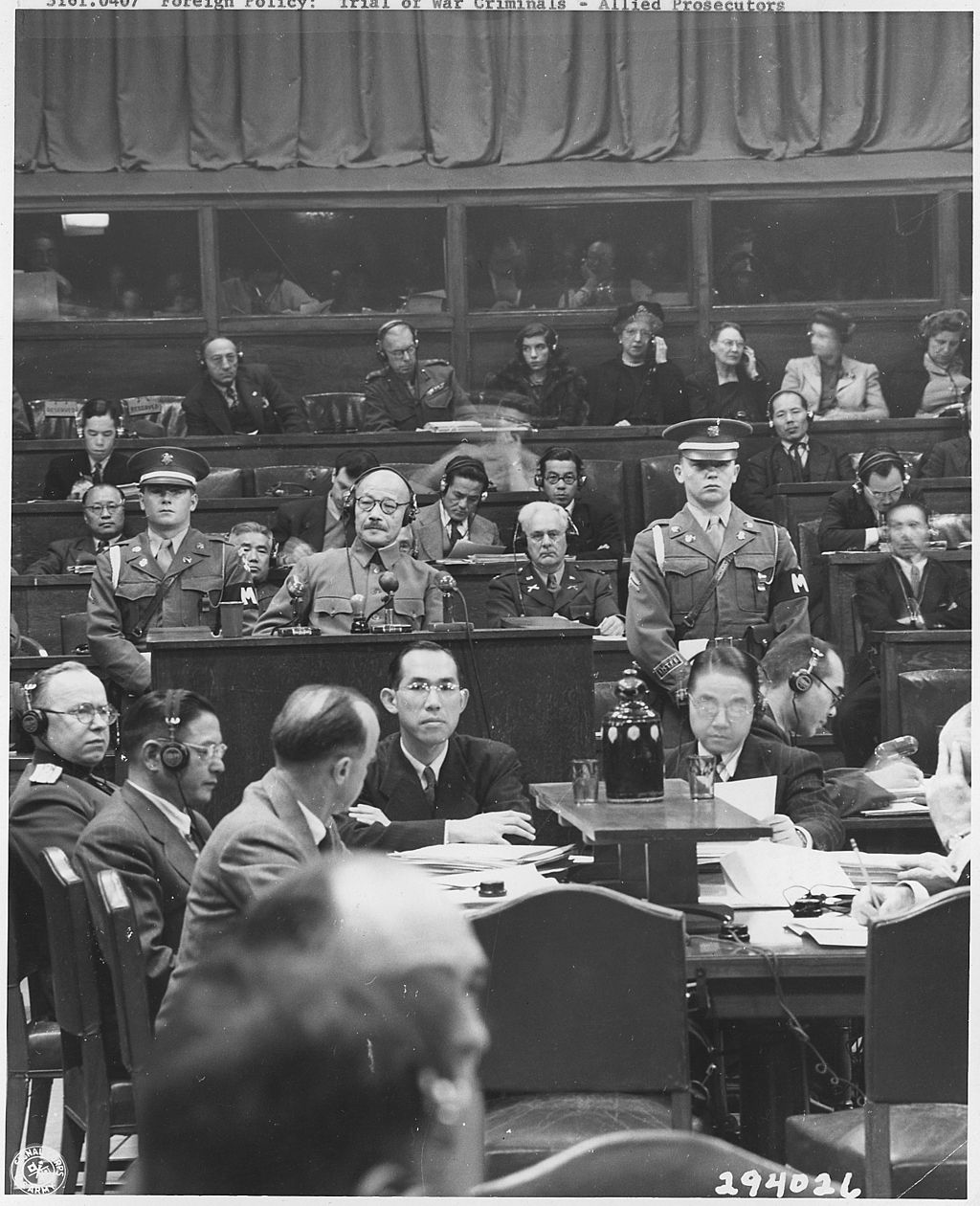
Tojo takes the stand at the Tokyo war crimes tribunal.
After the war years of hostility and warfare, the former enemies bound their destinies together beginning in the occupation years.’ Boyle
The organization of the occupation
In theory the occupation of Japan was to be under international control. In Washington there was a Far Eastern Commission which had representatives of all countries that had fought Japan. However, in practice the occupation was dominated by the US, and in particular the Supreme Commander for Allied Powers [SCAP], General MacArthur. MacArthur’s administration wanted to impose US values on Japanese society.
Historians disagree about the reasons SCAP wanted to impose US values in Japan. Beasley suggests this was partly due to an ignorance of Japanese society whereas Pyle argues this was a deliberate policy to ‘Americanize’ Japan.
Demilitarization
The first priority of the occupation was to demilitarize Japan which involved disbanding the military and secret police forces. More than 2 million men were demobilized in Japan and 3 million more were repatriated from abroad. In addition, more than 3 million civilians were repatriated. Military bases, arsenals and munitions factories were closed.
War crimes and the International Military Tribunal for the Far East
The International Military Tribunal for the Far East was established to put on trial those responsible for the war and war crimes. Prime Ministers Tojo and Hirota were sentenced to death, whereas other former leaders were given prison sentences. Thousands of officers were put on trial for ‘atrocities’ committed during the war. In 1946, there was a significant purge of officials who had held important posts during the war. Around 220,000 people were barred from holding office. However, as the US believed that the bureaucracy would be needed to run the government it was largely left unscathed in the purge.
Certain notable suspects were never put on trial, such as Masanobu Tsuji and Nobusuke Kishi. The Emperor Hirohito and the imperial family were granted immunity from prosecution by General MacArthur. In addition, the controversial Unit 731 which had conducted lethal human experimentation for biological and chemical warfare during the war was also given immunity.
Before the Tokyo war crimes tribunal MacArthur worked on attributing ultimate responsibility for the bombing of Pearl Harbor to Hideki Tojo - which would then spare others, including the Emperor, from indictment.
Task One
ATL: Research skills
In small groups briefly research the Tokyo war crimes tribunal and discuss the nature of the crimes of those indicted and the sentences the court imposed. Based on your research, discuss why the immunity given to the Imperial family and Unit 731 was opposed by some groups within Japan and by the international community.
Issue of Japanese armed forces and security
Japan renounced militarism at the end of the war, both willingly and under pressure from US. In 1952 Japan signed the Security Treaty authorizing the US to move troops into Japan. Under this agreement the US could resist invaders or ‘put down large scale disturbances’. Japan kept only a small defense force [at a cost of 1% of its budget]. The US stationed 55,000 troops in Japan and kept a powerful fleet in the region.
The Security Treaty was controversial in Japan. It seemed to violate Japanese sovereignty and it did not restrict the use of US bases or military forces. In the 1950s, socialists and communists, as well as students, argued against the Security Treaty on the grounds that Japan might be dragged into wars started by the US. Some government leaders wanted to solve this problem by making Japan take more responsibility for its own defense – but the left was opposed to this as it feared that this could lead to a return of military interference in politics. However, in 1955 the government set up a Self Defense Force stating it was for the national defense.
Anti-American sentiment increased in 1954 when a Japanese fishing boat was affected by fall out from a US H-bomb test at Bikini Atoll in the mid-Pacific. The incident strengthened the fear that the US activities in The Pacific were a threat to Japan’s safety.
In 1960, when the Security Treaty of 1952 needed to be renewed, the Japanese government signed a new treaty claiming that it gave Japan a better deal as the US now had to ask for the right to use US bases in Japan for operations against another Asian nation. Japan also gained the right to refuse US nuclear weapons in its country. Nevertheless, the left-wing in Japan was bitterly against the new treaty. It seemed to bind Japan even more closely to the US; the left claimed it was evidence of ‘US imperialism’. Some argued that the Treaty broke the 1947 constitution which stated that Japan could not be involved in a war. These strong feelings led to rioting which was so violent that a visit by US President Eisenhower had to be canceled. The same arguments continued throughout the 1970s and 1980s.
Task Two
ATL: Thinking and self-management skills
1.Make a copy of the chart below and add annotations and detail regarding the ways in which the US policy of demilitarization was implemented
2. As an extension task go here to see a full transcript of the Security Treaty.
Discuss with a partner the terms which ensured the demilitarization of Japan

4. How was the policy of democratization implemented in post-war Japan?
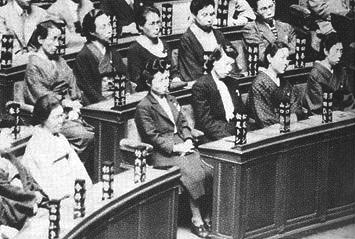
The first women to sit in the Japanese Diet, 1946
Starter:
In pairs discuss what features you would expect to see in a thriving democracy.
Task One
ATL: Thinking skills
Continue watching the documentary, Japan under Occupation from 15.06 to 18.27 and then from 25.48
Answer the following questions:
- What evidence did the US have of Emperor Hirohito’s involvement in the execution of the war?
- What deal did MacArthur strike with Hirohito?
- What happened on October 14th 1945?
- What specific limitations were there to the removal of censorship in Japan?
- Why did MacArthur decide to impose a constitution of his own on Japan and how long did he give his staff to draft one?
- What was the response to the women’s rights articles of the new constitution?
- What was considered the most ‘innovative’ clause of the new constitution?
- Who did MacArthur give credit to for this clause?
- Who did MacArthur use to promote the ‘democratic constitution’?
- When was the first ‘free’ election held in post-war Japan and how many women cast their vote?
Task Two
ATL: Thinking skills
Read the following summary of the democratic changes introduced into Japan.
- What features of a democracy were implemented in Japan? (Refer back to your starter task at the start of this section regarding features of a democracy)
- Which measures were controversial and why?
On October 4, 1945, the directive for the Removal of Restrictions on Political, Civil and Religious Liberties was issued. This ordered the release of political prisoners, and subsequently about 2,500 opponents of the pre-war Japanese governments, including communists, socialists, liberals, and trade union leaders were set free from prison in an amnesty. A Japanese ‘bill of rights’ was also proclaimed.
General MacArthur rejected the idea of removing the Emperor as he believed a ‘cooperative’ Emperor would help the occupation gain public acceptance for its reforms. After MacArthur worked on establishing a sound relationship with him, Emperor Hirohito, on 1st January 1946, made his ‘Declaration of Humanity’ in which he rejected his divine status. Hirohito also rejected the concept that the Japanese were superior to other races and nations.
A new constitution was deemed essential by the US. Although, the new constitution was presented as the work of the Japanese government it had been largely constructed by the US. It came into force in May 1947. The new constitution described the Emperor merely as the ‘symbol of the state’ and sovereign power resided with the Japanese people. The new constitution renounced war and the armed forces. The former House of Peers was replaced by an elected House of Councillors, and the House of Representatives was the more powerful. The Cabinet was responsible to parliament and the House of Representatives elected the Prime Minister. Functions that had been performed by the central government were now the responsibility of local government. Local government was also democratized with elected governors, mayors and local assemblies. An independent judiciary was established with a new Supreme Court, and basic human rights were protected, including gender equality . This was controversial in Japan as the provision of legal and political equality for women required some changes to the Civil Code and this affected, for example, the powers of the male head of a family.
Although all censorship and controls on freedom of speech were abolished at the beginning of the occupation, and included in Article 21 of the constitution, press censorship remained. This was not only the censorship of pornography but also of political matters that may be seen as subversive by SCAP. SCAP suppressed information about rapes that its troops were accused of. However, the mention of censorship was forbidden.
Also see this in-depth analysis by the Council of Foreign Relations of the steps involved in setting up of the Japanese constitution
Task Three
ATL: Thinking skills
Read the following extract on 'The Reverse Course'
- In what ways did the US reverse its original democratic reforms?
- Why did the US do this?
- What was the significance of this change of policy for Japan?
As the Grand Alliance broke down after the Second World War and the superpower confrontation between the US and USSR developed, the attitude of the occupiers in Japan began to change in late 1947. The new focus became the promotion of economic recovery.
The earlier policies towards left-wingers was reversed and some communists were purged. Thousands of left wing officials were removed from government and positions within trade unions. The US also became less supportive of strikes. The National Public Service Law was revised to prevent strikes by government employees. Attempts to break up the powerful zaibatsu was abandoned. Then, in 1950 Japan was permitted to set up a 75,000 paramilitary force responsible for its own security. This force was called the National Police Reserve.
Some attempts were made in the 1950s to amend the constitution to make it more conservative. However, even during the occupation the 'reverse course' meant that there was a shift in who was deemed politically acceptable and in 1949 purge regulations were altered to include left-wingers. The result of the 'red purge' was that around 22,000 people lost their jobs. At the same time the Japanese government was permitted to ‘review’ the cases of militarists purged in 1946 and 1947 which led many to have their political status restored. In 1948 strikes by civil servants were prohibited and this was extended in 1950 to all public sector workers.
The US reforms had decentralized the control of the police, but after 1951 these laws were amended and by 1954 all police came under the authority of the National Police agency. The director of this agency was appointed by the National Public Safety Commission, with the consent of the Prime Minister.
The US abolished the Home Ministry and its functions were given to other departments.
At first there was much switching of party labels after 1945. In the first post-war elections there were some 200 parties competing. For most of the first decade the most powerful party was the Liberal party, led by Yoshida. Yoshida had formerly been a bureaucrat and had been briefly imprisoned by the military police during the war. Yoshida was Prime Minister for most of the period between 1946 and 1955
Throughout the period of occupation Japan had its own government. Associated with liberal foreign policy objectives in the 1920s, Shidehara led the government between October 1945 and May 1946. He was succeeded by Yoshida who then went on to hold power for most of the post-war decade. Indeed, Historian Pyle argues that Yoshida was so dominant in the post-war political scene that he was referred to as ‘One Man’ Yoshida.
Distinctive features of Japanese politics.
- Domination of conservatives. Conservative parties, the Liberals, Democrats and then the Liberal Democrats were in power for almost 50 years, apart from a brief interlude between 1947-48.
- Bureaucrats played a more significant role in Japanese politics than in other democracies. This group was not particularly weakened by the occupation. In 1949 Yoshida managed to get elite bureaucrats to join the Liberal Party.
- Factions within a party were not due to policy differences but tended to be linked to support for, or loyalty to, one leading figure.
Task Four
ATL: Thinking and communication skills
Under the banner headline: ‘Turning Japan into a democratic nation’ draft a newspaper report detailing the political policies implemented after 1945 and how these have ‘democratized’ Japan.
Task Five
ATL: Research skills
Historian Kenneth Pyle argues that Yoshida was ‘…one of the most important figures in modern Japanese history’ and argues that it was Yoshida, rather than SCAP and US policies that laid the foundation for the long term dominance of the Liberal democrats in Japan.
In pairs research the political role played by Yoshida during the occupation up to 1952 and discuss how far you agree with Pyle's assessment.
Task Six
ATL: Research and thinking skills
Go to full transcript of the Treaty of San Francisco here
Discuss the terms with a partner and identify where the treaty ensures the democratization of Japan
5. What economic reforms were implemented during the occupation?
You will be studying the economic recovery and revival that occurred in post war Japan in the next unit. However, it is important to briefly cover the economic policies of the occupation to provide context for the political, social and cultural reforms implemented.
In order to make Japan a strong anti-communist ally, the US assisted with reconstruction after the war and helped it to re-enter international markets. Significant trade developed with the US, particularly in agricultural goods and technology. The Japanese economy was also greatly boosted by the Korean War.
At first the US did not see the Japanese economic revival as a threat; the Cold War was more important. However, by the end of the 1960s ‘trade friction’ had developed as Japan produced excellent products at a low cost.
Economic reforms
SCAP implemented a number of economic reforms. You have already seen that part of the initial policies of SCAP were to redress the food crisis and to provide loans to foster economic recovery. This was important not only to end the widespread starvation and financial dependency on the US, but it was deemed essential in order to build a democratic Japan.
Reforms such as the Trade Union Act, passed in December 1945, which guaranteed the right of workers to form trade unions and to strike also had political connotations. This act led to a rapid increase in trade union membership. By June 1948, union membership had swelled to 6.5 million. The Labor Standards Act 1947 also gave workers health insurance and accident compensation. This had socio-economic outcomes as it improved living standards.
The US wanted to break up the formerly powerful zaibatsu, and to this end, key holding companies were abolished. Measures were passed to foster an increase in share ownership and share-holding became more widespread. In addition, land reform was implemented which aimed to increase land ownership and reduce tenancies. The land reform law came into effect in October 1946. This met with some opposition from the Japanese. It provided for the compulsory purchase of all land held by absentee landlords. Resident landlords and farmers that owned land had the amount of land they could hold limited. The government then bought the ‘excess’ land and offered it for purchase to tenants at favorable rates. The result was a dramatic change in land ownership in Japan. Between 1946 and 1950 land tenancy decreased from 40% to 10%.
Task One
ATL: Thinking and communication skills
Get into groups of four.
Take it in turns for one pair to ask about a reform, for example the Labor Standards Act of 1947, and the other pair to explain its socio-economic impact on Japanese society.
6. What social reforms were implemented and what was the cultural impact of the US occupation?
The Emperor’s surrender broadcast to his people had come as a shock as the Japanese public had been consistently told during the war that ultimate victory was inevitable. In September 1945 industry and the infrastructure were devastated, there was an acute housing shortage and widespread starvation. The food shortage was further aggravated by the cessation of food imports from Korea, China and Taiwan and the 5.1 million people returning from occupations, deployments and Japan’s former colonies. Acute social problems of drug and alcohol abuse were common; there was gang related violence due to a flourishing black market and the population was exhausted.
The phrase ‘nothing can be done about it’ or ‘shikata ga nai’ was used in both the US and Japanese press to describe the public’s acceptance of the hardships that needed to be endured. Nevertheless, some Japanese did see the occupation as a liberating force.
SCAP implemented a series of social reforms during the occupation. A new civil code came into effect on January 1st 1948. This set down the principle of equality of the sexes which would determine property rights and inheritance. Marriage was to be based on mutual consent.
Education reforms placed education under the control of locally elected boards of education instead of the Ministry of Education. The structure of Japanese schools followed the US model of elementary, junior high and senior high school. The Fundamental Law of Education of 1947 replaced the 1890 rescript on education. This set down that the purpose of the education system would be to contribute to world peace by building a democratic and cultural state. A major change in the content of education was in the teaching of history. It has been argued that the quality of education in Japan was not necessarily improved by these changes.
The occupation had put education under the control of elected assemblies. The subject of ethics had been abolished and replaced by ‘civics’. In 1951 there was an attempt by the government to reintroduce ethics – but a public outcry halted the proposal.
Task One
ATL: Thinking skills
Continue with the video Japan under Occupation from 32.30.
Make brief notes on the cultural impact of the occupation on Japan.
Task Two
ATL: Research and communication skills
In pairs investigate further into the cultural impact of the occupation on Japanese society.
Consider the following areas. For each area consider the situation that had existed before the war, the aims of SCAP in this area, measures taken and overall impact of SCAP.
Women
Workers
Religion
Education
Family
Create an infographic that details the social and cultural effects of the US occupation up to 1952. Share this with your class.
7. To what extent was Japan changed by the US Occupation?
.png)
Task One
ATL: Thinking and self-management skills
1. In pairs read through the chart above and discuss the balance of change and continuity in Japan by the end of the occupation.
2. Print off the worksheet below (or click on the eye); identify which points/boxes outline a change and which detail a continuity.
 Activity on change or continuity in Japan after 1945
8. What are the views of historians on the impact of the US occupation?
Task One
ATL: Thinking and self-management skills
Read the views of historians in the chart below. Review the information you have covered in this unit and discuss with a partner whose viewpoint you find most convincing and why.
.png)
Task Two
ATL: Thinking skills
Read the source and answer the questions that follow:
Extract from an academic history book, entitled Japan, a story of a nation, [1989] by historian Edwin O Reischauer. Reischauer was born in Toyko, Japan to US missionary parents, and later served as US ambassador to Japan between 1961 and 1966.
Most of the truly important postwar changes seem to be simply the acceleration of changes that were already taking place in pre-war Japan… The war and the occupation between them seem to have swept away barrier to the forward motion of these currents. So, instead of diverting Japan into a new channel, the occupation cleared the old one of the obstruction of militaristic reaction and changed a slow and meandering stream into a rushing torrent.
Questions:
- What, according to Reischauer was the main impact of the US post-war occupation of Japan?
- With reference to its origin, purpose and content, analyse the value and limitations of this source for historians studying the impact of the occupation.
- Historian R Ward suggests that most US scholars in 1950s and 1960s viewed the occupation as a positive example of ‘planned political change’ that successfully built on pre-war developments. To what extent do you agree with this viewpoint?
9. To what extent did SCAP achieve the objectives outlined in 1945?
‘There can be no doubt that Japan became locked into the status of junior partner in its relations with the US and that this relationship prevailed beyond the occupation and left Japan incapable or unwilling to exercise autonomy in the conduct of its international affairs.’ Boyle.
Task One
ATL: Thinking and self-management skills
Refer back to the original aims of SCAP.
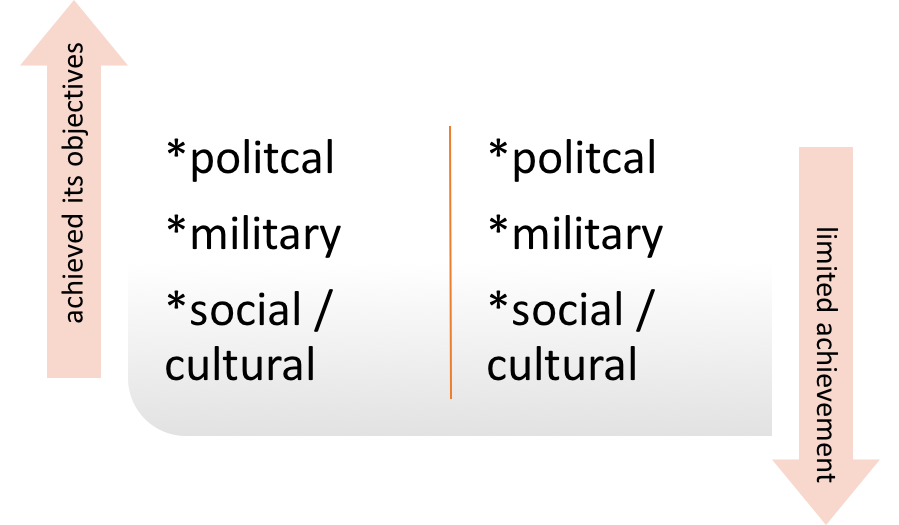
In pairs make a copy of the chart below and add evidence and historiography to support the line of argument that the occupation a] achieved its objectives b] limited achievement
Refer to the information below to help you complete the chart.
- The policy set down by the US Initial Post-surrender Policy and Joint Chief’s directive of democratizing Japan was achieved by the establishment of a new constitution which continued to be democratic after the occupation
- The demilitarization of Japan was achieved by the demobilization of the military and through Article IX of the constitution. After the occupation Japan had no independent capacity for aggression
- The role of SCAP was significant. However, the Japanese government and people also adapted these objectives to their own national interests.
J Williams and Theodore Cohen, who worked for SCAP, highlighted the key role played by General MacArthur, arguing his far-sighted approach converted ‘a stern occupation of control and restraint into one of reconciliation and cooperation. MacArthur protected Japan from reparation assaults, insisted on disproportionate food imports and inspired the Japanese nation once more to believe in itself.’ However, Jon Halliday emphasized the role of the reverse course during the occupation. Halliday suggests that the legacy of the occupation was a new conservative hegemony within Japan - strongly supported by the US.
Historians, Sheldon Garon and Howard Schonberger, writing in the 1980s and 1990s, suggest that the occupation was a highly complex period, characterised by continuity as well as change. There were reactionary as well as progressive influences. MacArthur’s role is deemed less significant than other SCAP officials.
 Twitter
 Facebook
 LinkedIn