• IB
  • IB Docs (2) Team
    Logout
  • Maths
  • Biology
  • Chemistry
  • Physics
  • Combined Science
  • English Language
  • Geography
  • Other Subjects
GCSE Maths
Edexcel Topic QuestionsRevision NotesPast PapersPast Papers Questions
AQA Topic QuestionsRevision NotesPast Papers
OCR Topic QuestionsRevision NotesPast Papers
GCSE Biology
Edexcel Topic QuestionsRevision NotesPast Papers
AQA Topic QuestionsRevision NotesPast Papers
OCR Gateway Topic QuestionsRevision NotesPast Papers
GCSE Chemistry
Edexcel Topic QuestionsRevision NotesPast Papers
AQA Topic QuestionsRevision NotesPast Papers
OCR Gateway Topic QuestionsRevision NotesPast Papers
GCSE Physics
Edexcel Topic QuestionsRevision NotesPast Papers
AQA Topic QuestionsRevision NotesPast Papers
OCR Gateway Topic QuestionsRevision NotesPast Papers
GCSE Combined Science
Edexcel Combined: Biology Topic QuestionsRevision NotesPast Papers
Edexcel Combined: Chemistry Topic QuestionsRevision NotesPast Papers
Edexcel Combined: Physics Revision NotesPast Papers
AQA Combined: Biology Topic QuestionsRevision NotesPast Papers
AQA Combined: Chemistry Topic QuestionsRevision NotesPast Papers
AQA Combined: Physics Topic QuestionsRevision NotesPast Papers
OCR Gateway Combined: Biology Topic QuestionsRevision Notes
OCR Gateway Combined: Chemistry Revision Notes
OCR Gateway Combined: Physics Revision Notes
GCSE English Language
AQA Revision NotesPractice PapersPast Papers
Edexcel Past Papers
OCR Past Papers
GCSE Geography
AQA Topic QuestionsRevision Notes
Edexcel Topic Questions
GCSE Other Subjects
AQA English LiteratureBusinessComputer ScienceEconomicsFurther MathsGeographyHistoryPsychologySociologyStatistics
Edexcel English LiteratureBusinessComputer ScienceGeographyHistoryPsychologyStatistics
OCR English LiteratureBusinessComputer ScienceEconomicsPsychology
OCR Gateway GeographyHistory
  • Maths
  • Biology
  • Chemistry
  • Physics
  • Double Science
  • Economics
  • English Language
  • Geography
  • Other Subjects
IGCSE Maths
Edexcel Topic QuestionsRevision NotesPast PapersBronze-Silver-Gold Questions
CIE (Extended) Topic QuestionsRevision NotesPast Papers
CIE (Core) Topic QuestionsPast Papers
IGCSE Biology
Edexcel Topic QuestionsRevision NotesPast Papers
CIE 2020-2022 Topic QuestionsRevision NotesPast Papers
CIE 2023-2025 Topic QuestionsRevision NotesPast Papers
IGCSE Chemistry
Edexcel Topic QuestionsRevision NotesPast Papers
CIE 2020-2022 Topic QuestionsRevision NotesPast Papers
CIE 2023-2025 Topic QuestionsRevision NotesPast Papers
IGCSE Physics
Edexcel Topic QuestionsRevision NotesPast Papers
CIE 2020-2022 Topic QuestionsRevision NotesPast Papers
CIE 2023-2025 Topic QuestionsRevision NotesPast Papers
IGCSE Double Science
Edexcel Double: Biology Topic QuestionsRevision NotesPast Papers
Edexcel Double: Chemistry Topic QuestionsRevision NotesPast Papers
Edexcel Double: Physics Topic QuestionsRevision NotesPast Papers
IGCSE Economics
CIE Topic QuestionsRevision NotesPast Papers
IGCSE English Language
CIE Revision NotesPractice PapersPast Papers
Edexcel Past Papers
IGCSE Geography
CIE Revision NotesTopic QuestionsPast Papers
Edexcel Topic QuestionsRevision NotesPast Papers
IGCSE Other Subjects
CIE Additional MathsEnglish LiteratureBusinessComputer ScienceHistorySociology
Edexcel English LiteratureBusinessComputer ScienceHistoryFurther Maths
  • Maths
  • Biology
  • Chemistry
  • Physics
  • English Language
  • Other Subjects
AS Maths
Edexcel Pure MathsMechanicsStatistics
AQA Pure MathsMechanicsStatistics
OCR Pure MathsMechanicsStatistics
CIE Pure 1Pure 2MechanicsProbability & Statistics 1
Edexcel IAS Pure 1Pure 2MechanicsStatistics
AS Biology
AQA Topic QuestionsRevision NotesPast Papers
OCR Topic QuestionsRevision NotesPast Papers
CIE 2019-2021 Topic QuestionsRevision NotesPast Papers
CIE 2022-2024 Topic QuestionsRevision NotesPast Papers
Edexcel IAL Revision Notes
AS Chemistry
Edexcel Revision Notes
AQA Topic QuestionsRevision NotesPast Papers
OCR Revision Notes
CIE 2019-2021 Topic QuestionsRevision NotesPast Papers
CIE 2022-2024 Topic QuestionsRevision NotesPast Papers
Edexcel IAL Revision Notes
AS Physics
Edexcel Revision Notes
AQA Topic QuestionsRevision NotesPast Papers
OCR Revision NotesPast Papers
CIE 2019-2021 Topic QuestionsRevision NotesPast Papers
CIE 2022-2024 Topic QuestionsRevision NotesPast Papers
Edexcel IAL Revision Notes
AS English Language
AQA Past Papers
Edexcel Past Papers
OCR Past Papers
AS Other Subjects
AQA BusinessComputer ScienceEconomicsEnglish LiteratureFurther MathsGeographyHistoryPsychologySociology
Edexcel BusinessEconomicsEnglish LiteratureFurther MathsGeographyHistoryPsychology
OCR BusinessComputer ScienceEconomicsEnglish LiteratureFurther Maths AGeographyHistoryPsychologySociology
CIE Further Maths
  • Maths
  • Biology
  • Chemistry
  • Physics
  • English Language
  • Economics
  • Further Maths
  • Psychology
  • Other Subjects
A Level Maths
Edexcel Pure MathsMechanicsStatistics
AQA Pure MathsMechanicsStatistics
OCR Pure MathsMechanicsStatistics
CIE Pure 1Pure 3MechanicsProbability & Statistics 1Probability & Statistics 2
Edexcel IAL Pure 1Pure 2Pure 3Pure 4Mechanics 1Mechanics 2Statistics 1Statistics 2Decision 1
A Level Biology
Edexcel Topic QuestionsPast Papers
Edexcel A (SNAB) Revision Notes
AQA Topic QuestionsRevision NotesPast Papers
OCR Topic QuestionsRevision NotesPast PapersGold Questions
CIE 2019-2021 Topic QuestionsRevision NotesPast Papers
CIE 2022-2024 Topic QuestionsRevision NotesPast Papers
Edexcel IAL Topic QuestionsRevision NotesPast Papers
A Level Chemistry
Edexcel Topic QuestionsRevision NotesPast Papers
AQA Topic QuestionsRevision NotesPast Papers
OCR Topic QuestionsRevision NotesPast PapersGold Questions
CIE 2019-2021 Topic QuestionsRevision NotesPast Papers
CIE 2022-2024 Topic QuestionsRevision NotesPast Papers
Edexcel IAL Topic QuestionsRevision NotesPast Papers
A Level Physics
Edexcel Topic QuestionsRevision NotesPast Papers
AQA Topic QuestionsRevision NotesPast Papers
OCR Topic QuestionsRevision NotesPast Papers
CIE 2019-2021 Topic QuestionsRevision NotesPast Papers
CIE 2022-2024 Topic QuestionsRevision NotesPast Papers
Edexcel IAL Topic QuestionsRevision NotesPast Papers
A Level English Language
AQA Past Papers
CIE Past Papers
Edexcel Past Papers
OCR Past Papers
Edexcel IAL Past Papers
A Level Economics
Edexcel Topic QuestionsRevision NotesPast Papers
AQA Topic QuestionsPast Papers
OCR Past Papers
CIE Past Papers
A Level Further Maths
Edexcel Topic QuestionsRevision NotesPast Papers
AQA Past Papers
OCR Past Papers
CIE Past Papers
Edexcel IAL Past Papers
A Level Psychology
AQA Topic QuestionsRevision NotesPast Papers
CIE Past Papers
Edexcel Past Papers
OCR Past Papers
Edexcel IAL Past Papers
A Level Other Subjects
AQA BusinessComputer ScienceEconomicsEnglish LiteratureGeographyHistorySociology
CIE BusinessComputer ScienceEconomicsEnglish LiteratureGeographySociology
Edexcel BusinessEconomics AEnglish LiteratureGeographyHistory
OCR BusinessComputer ScienceEconomicsEnglish LiteratureGeographyHistorySociology
Edexcel IAL English LiteratureGeography
CIE IAL History
  • Biology
  • Chemistry
  • Physics
  • Other Subjects
O Level Biology
CIE Topic QuestionsPast Papers
O Level Chemistry
CIE Topic QuestionsPast Papers
O Level Physics
CIE Topic QuestionsPast Papers
O Level Other Subjects
CIE Additional MathsMaths D
  • Maths
  • Biology
  • Chemistry
  • Physics
Pre U Maths
CIE Topic QuestionsPast Papers
Pre U Biology
CIE Topic QuestionsPast Papers
Pre U Chemistry
CIE Topic QuestionsPast Papers
Pre U Physics
CIE Topic QuestionsPast Papers
  • Maths
  • Biology
  • Chemistry
  • Physics
  • Economics
IB Maths
Maths: AA HL Topic QuestionsRevision NotesPractice Papers
Maths: AI HL Topic QuestionsRevision NotesPractice Papers
Maths: AA SL Topic QuestionsRevision NotesPractice Papers
Maths: AI SL Topic QuestionsRevision NotesPractice Papers
IB Biology
Biology: SL Topic QuestionsRevision NotesPractice Papers
Biology: HL Topic QuestionsRevision NotesPractice Papers
IB Chemistry
Chemistry: SL Topic QuestionsRevision NotesPractice Papers
Chemistry: HL Topic QuestionsRevision NotesPractice Papers
IB Physics
Physics: SL Topic QuestionsRevision NotesPractice Papers
Physics: HL Topic QuestionsRevision NotesPractice Papers
IB Economics
Economics: SL Revision Notes

SL IB Economics

Revision Notes

Home / IB / Economics / SL / Revision Notes / 4. The Global Economy / 4.3 Arguments For & Against Trade Protection / 4.3.1 Arguments For & Against Trade Protection


4.3.1 Arguments For & Against Trade Protection


Arguments for Trade Protection

  • Despite the benefits that free trade offers, there are many good arguments which would support the use of protectionism in certain instances
      

Arguments for Protectionism


Reason


Explanation


Infant industries


  • To protect new firms that would be unlikely to succeed at start-ups due to the level of global competition. Once established support is removed 

Sunset industries


  • Similar to above, but at the other end of the life cycle, these firms are on their way out and the government chooses to support them to help limit the economic damage that would occur if they closed abruptly

Strategic industries


  • Industries such as energy, defence and agriculture are essential to self-sufficiency and security. Being reliant on other countries for these creates vulnerabilities for a nation


Dumping


  • Dumping is anti-competitive and can harm a country's industries

Employment


  • When firms outsource production to other countries or certain industries are experiencing structural unemployment governments will step in to protect jobs

Current Account deficit 


  • When imports > exports the amount of money leaving the country to support foreign firms is greater than that entering to support domestic firms. Protectionism aims to correct this imbalance

 Labour/environmental regulations


  • Many countries offer cheap labour and low-cost production due to poor environmental regulations. Protectionism can help apply pressure to bring about change in these countries

Arguments Against Trade Protection

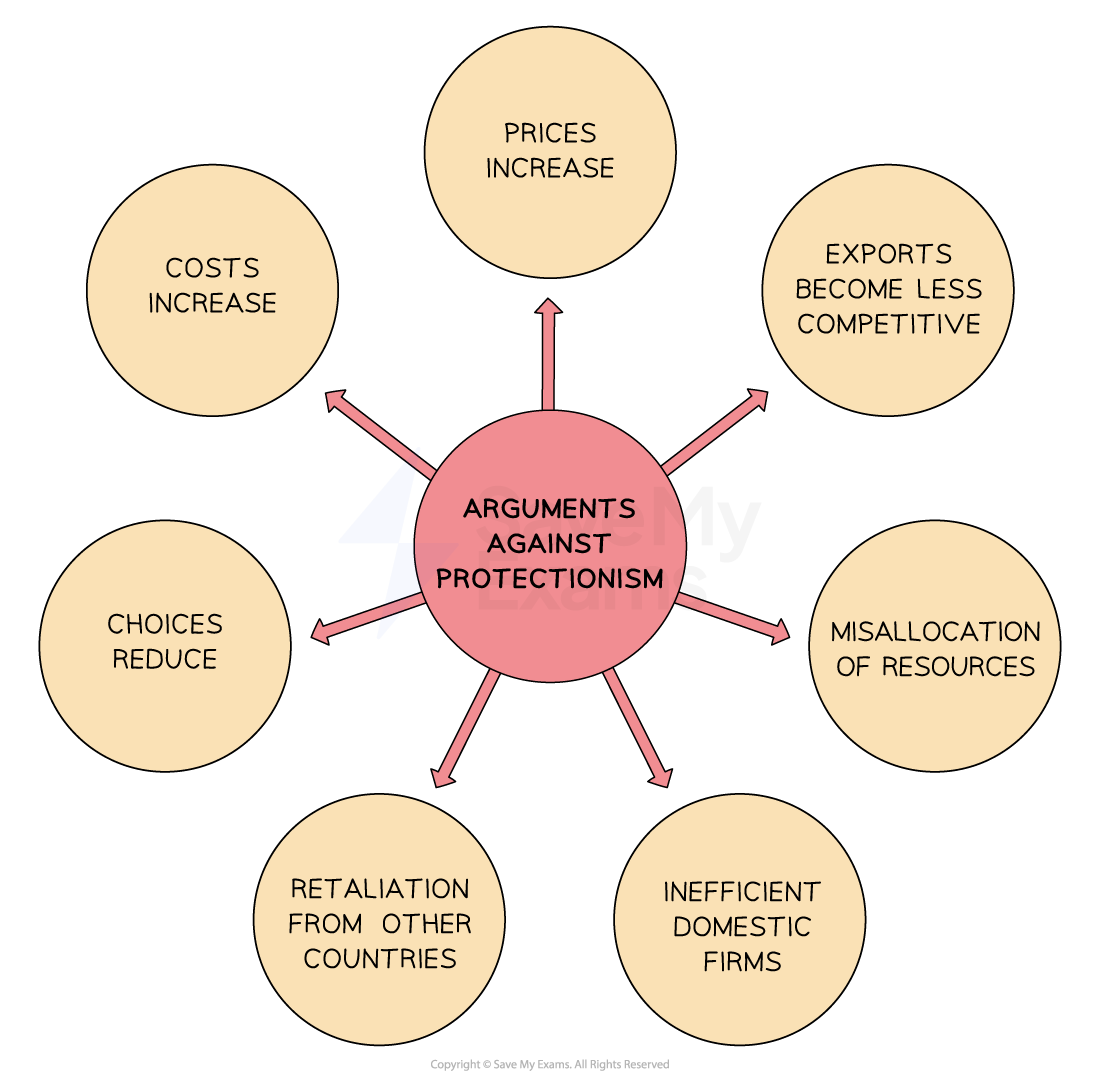
  • The arguments against trade protection are evident from the impact that each form of protection has on the stakeholders. These can be summarised in the diagram below
4-3-1-arguments-against-trade-protection

Seven common arguments against protectionism


  1. Reduced choice
    Protectionism reduces both the quantity and variety of goods/services available to customers
  2. Increased prices
    Protectionism either reduces the supply of goods/services which leads to higher prices - or in the case of tariffs, directly leads to higher prices
  3. Increased costs
    Manufacturers who rely on imported raw materials face higher costs of production. If protectionism is widespread it may generate inflation in the economy and/or lead to a loss of employment
  4. Retaliation
    Foreign producers are hurt by protectionism and it is common for their governments to retaliate with their own measures which further harm free trade
  5. Reduction in export competitiveness
    Protectionism reduces the need to be efficient or to innovate. Over time this leads to higher prices and worse quality products which will reduce export sales
  6. Resource misallocation
    Global welfare is reduced as protectionism shifts production away from more efficient foreign producers to less efficient domestic producers
  7. Domestic inefficiency increases
    With a reduced level of competition, domestic firms will be less productively efficient and will spend less on research, development and  innovation

An Evaluation of free Trade Versus Protectionism

  • Trade liberalisation has helped to generate significant economic growth and economic development
     
  • As an economy moves towards free trade, structural unemployment often develops as certain industries move abroad
    • Without an intentional government program to retrain these workers, they often fall through the cracks and their quality of life reduces significantly
    • It has been argued that structural unemployment is at the heart of nationalism as angry workers seek to expel foreigners and get their jobs back
    • Voters are able to influence the political agenda and protectionism goes through periods of immense popularity
       
  • More economically developed countries (MEDCs) have the funds available to provide significant export subsidies to their firms
    • The aim is usually not to protect these firms but to help them gain a global monopoly
    • As monopolies develop they gain more revenue and generate more tax revenue which may go back to their government (often it goes to off-shore bank accounts)
        
  • Less economically developed countries (LEDCs) are often pushed into free trade agreements by MEDCs with a focus on resource extraction
    • MEDCs frequently place tariffs on the import of manufactured goods with added value from LEDCs
    • This prevents LEDCs from generating higher profits e.g. cocoa beans are exported from Ghana to the USA at low prices and without any import tariffs, however, there is a high tariff on the import of Ghanaian chocolate to the USA
       
  • This argument is not as simple as free trade is better. The context of the trade and the nature of the trading partners ultimately decides whether a path of free trade or protectionism would serve a nation better
    • There is no doubt free trade generates higher output and income, but the distribution of this income may be vastly unfair


  • 1. Introduction To Economics
    • 1.1 What Is Economics?
      • 1.1.1 Economics as a Social Science
        • 1.1.2 The Problem of Choice
          • 1.1.3 The Production Possibilities Curve Model (PPC)
            • 1.1.4 Modelling the Economy
            • 1.2 How Do Economists Approach The World?
              • 1.2.1 Economic Methodology
                • 1.2.2 Economic Thought
              • 2. Microeconomics
                • 2.1 Demand
                  • 2.1.1 Demand, Price & Quantity
                    • 2.1.2 Non-Price Determinants of Demand
                    • 2.2 Supply
                      • 2.2.1 Supply, Price & Quantity
                        • 2.2.2 Non-Price Determinants of Supply
                        • 2.3 Competitive Market Equilibrium
                          • 2.3.1 Market Equilibrium & Disequilibrium
                            • 2.3.2 Functions of the Price Mechanism
                              • 2.3.3 Consumer & Producer Surplus
                              • 2.4 Price Elasticity of Demand (PED)
                                • 2.4.1 Definition, Calculation & Determinants of PED
                                  • 2.4.2 The Significance of PED
                                  • 2.5 Income Elasticity of Demand (YED)
                                    • 2.5.1 Definition, Calculation & Illustration of YED
                                    • 2.6 Price Elasticity of Supply (PES)
                                      • 2.6.1 Definition, Calculation & Determinants of PES
                                      • 2.7 Role of Government In Microeconomics
                                        • 2.7.1 Reasons For Government Intervention In Markets
                                          • 2.7.2 Government Intervention: Indirect Taxes & Subsidies
                                            • 2.7.3 Government Intervention: Price Controls, Direct Provision & Regulation
                                            • 2.8 Market Failure: Externalities & Common Pool (Access) Resources
                                              • 2.8.1 Market Failure
                                                • 2.8.2 Negative Externalities
                                                  • 2.8.3 Positive Externalities
                                                    • 2.8.4 Common Pool (Access) Resources
                                                      • 2.8.5 Government Intervention to Address the Market Failure
                                                        • 2.8.6 Other Interventions to Address the Market Failure
                                                        • 2.9 Market Failure: Public Goods
                                                          • 2.9.1 Public Goods
                                                        • 3. Macroeconomics
                                                          • 3.1 Measuring Economic Activity
                                                            • 3.1.1 National Income & The Circular Flow of Income
                                                              • 3.1.2 National Income Terminology & Calculations
                                                                • 3.1.3 The Business Cycle
                                                                  • 3.1.4 Appropriateness of Using GDP/GNI to Measure Well-being
                                                                    • 3.1.5 Alternative Measures of Well-Being
                                                                    • 3.2 Variations in Economic Activity (AD & AS)
                                                                      • 3.2.1 Aggregate Demand (AD)
                                                                        • 3.2.2 Short-Run Aggregate Supply (SRAS)
                                                                          • 3.2.3 Alternative Views of Aggregate Supply (AS)
                                                                            • 3.2.4 Shifts of the Long-Run Aggregate Supply (LRAS)
                                                                              • 3.2.5 Macroeconomic Equilibrium
                                                                              • 3.3 Macroeconomic Objectives
                                                                                • 3.3.1 An Introduction to Macroeconomic Objectives
                                                                                  • 3.3.2 Economic Growth
                                                                                    • 3.3.3 Low Unemployment
                                                                                      • 3.3.4 Low & Stable Rate of Inflation
                                                                                        • 3.3.5 Potential Conflicts Between Macroeconomic Objectives
                                                                                        • 3.4 Inequality & Poverty
                                                                                          • 3.4.1 Measuring Inequality & Poverty
                                                                                            • 3.4.2 Causes of Inequality & Poverty
                                                                                              • 3.4.3 Using Taxation to Reduce Inequality & Poverty
                                                                                                • 3.4.4 Other Policies to Reduce Inequality & Poverty
                                                                                                • 3.5 Demand Management: Monetary Policy
                                                                                                  • 3.5.1 An Overview of Monetary Policy
                                                                                                  • 3.6 Demand Management: Fiscal Policy
                                                                                                    • 3.6.1 An Overview of Fiscal Policy
                                                                                                    • 3.7 Supply-Side Policies
                                                                                                      • 3.7.1 An Overview of Supply-Side Policies
                                                                                                        • 3.7.2 The Effectiveness of Supply-Side Policies
                                                                                                      • 4. The Global Economy
                                                                                                        • 4.1 Benefits of International Trade
                                                                                                          • 4.1.1 The Advantages of Free Trade
                                                                                                          • 4.2 Types of Trade Protection
                                                                                                            • 4.2.1 Tariffs
                                                                                                              • 4.2.2 Quotas
                                                                                                                • 4.2.3 Export Subsidies
                                                                                                                  • 4.2.4 Administrative Barriers
                                                                                                                  • 4.3 Arguments For & Against Trade Protection
                                                                                                                    • 4.3.1 Arguments For & Against Trade Protection
                                                                                                                    • 4.4 Economic Integration
                                                                                                                      • 4.4.1 Understanding Economic Integration
                                                                                                                        • 4.4.2 Types of Trading Blocs
                                                                                                                          • 4.4.3 The World Trade Organisation (WTO)
                                                                                                                          • 4.5 Exchange Rates
                                                                                                                            • 4.5.1 Types of Exchange Rate Systems
                                                                                                                              • 4.5.2 Causes & Consequences of Exchange Rate Fluctuations
                                                                                                                              • 4.6 Balance of Payments
                                                                                                                                • 4.6.1 Components of the Balance of Payments
                                                                                                                                • 4.7 Sustainable Development
                                                                                                                                  • 4.7.1 The Sustainable Development Goals
                                                                                                                                  • 4.8 Measuring Economic Development
                                                                                                                                    • 4.8.1 Single Indicators of Development
                                                                                                                                      • 4.8.2 Composite Indicators of Development
                                                                                                                                        • 4.8.3 Evaluating the Different Approaches
                                                                                                                                        • 4.9 Barriers to Economic Growth & Development
                                                                                                                                          • 4.9.1 Poverty Traps
                                                                                                                                            • 4.9.2 Economic, Political & Social Barriers
                                                                                                                                            • 4.10 Economic Growth & Development Strategies
                                                                                                                                              • 4.10.1 Trade Strategies, Diversification & Social Enterprise
                                                                                                                                                • 4.10.2 Market-Based & Interventionist Policies
                                                                                                                                                  • 4.10.3 Merit Goods & Inward Foreign Direct Investment
                                                                                                                                                    • 4.10.4 Foreign Aid & Development Assistance
                                                                                                                                                      • 4.10.5 Institutional Change
                                                                                                                                                        • 4.10.6 Evaluating Market Orientated Approaches Versus Government Intervention
                                                                                                                                                          • 4.10.7 Progress Towards Sustainable Development Goals

                                                                                                                                                        Author: Steve


                                                                                                                                                        Save My Exams Logo
                                                                                                                                                        Resources
                                                                                                                                                        Home Join Support

                                                                                                                                                        Members
                                                                                                                                                        Members Home Account Logout

                                                                                                                                                        Company
                                                                                                                                                        About Us Contact Us Jobs Terms Privacy Facebook Twitter

                                                                                                                                                        Quick Links
                                                                                                                                                        GCSE Revision Notes IGCSE Revision Notes A Level Revision Notes Biology Chemistry Physics Maths 2022 Advance Information

                                                                                                                                                         
                                                                                                                                                        © IB Documents (2) Team & u/aimlesskr
                                                                                                                                                        IBO was not involved in the production of, and does not endorse, the resources created by Save My Exams.