• IB
  • IB Docs (2) Team
    Logout
  • Maths
  • Biology
  • Chemistry
  • Physics
  • Combined Science
  • English Language
  • Geography
  • Other Subjects
GCSE Maths
Edexcel Topic QuestionsRevision NotesPast PapersPast Papers Questions
AQA Topic QuestionsRevision NotesPast Papers
OCR Topic QuestionsRevision NotesPast Papers
GCSE Biology
Edexcel Topic QuestionsRevision NotesPast Papers
AQA Topic QuestionsRevision NotesPast Papers
OCR Gateway Topic QuestionsRevision NotesPast Papers
GCSE Chemistry
Edexcel Topic QuestionsRevision NotesPast Papers
AQA Topic QuestionsRevision NotesPast Papers
OCR Gateway Topic QuestionsRevision NotesPast Papers
GCSE Physics
Edexcel Topic QuestionsRevision NotesPast Papers
AQA Topic QuestionsRevision NotesPast Papers
OCR Gateway Topic QuestionsRevision NotesPast Papers
GCSE Combined Science
Edexcel Combined: Biology Topic QuestionsRevision NotesPast Papers
Edexcel Combined: Chemistry Topic QuestionsRevision NotesPast Papers
Edexcel Combined: Physics Revision NotesPast Papers
AQA Combined: Biology Topic QuestionsRevision NotesPast Papers
AQA Combined: Chemistry Topic QuestionsRevision NotesPast Papers
AQA Combined: Physics Topic QuestionsRevision NotesPast Papers
OCR Gateway Combined: Biology Topic QuestionsRevision Notes
OCR Gateway Combined: Chemistry Revision Notes
OCR Gateway Combined: Physics Revision Notes
GCSE English Language
AQA Revision NotesPractice PapersPast Papers
Edexcel Past Papers
OCR Past Papers
GCSE Geography
AQA Topic QuestionsRevision Notes
Edexcel Topic Questions
GCSE Other Subjects
AQA English LiteratureBusinessComputer ScienceEconomicsFurther MathsGeographyHistoryPsychologySociologyStatistics
Edexcel English LiteratureBusinessComputer ScienceGeographyHistoryPsychologyStatistics
OCR English LiteratureBusinessComputer ScienceEconomicsPsychology
OCR Gateway GeographyHistory
  • Maths
  • Biology
  • Chemistry
  • Physics
  • Double Science
  • Economics
  • English Language
  • Geography
  • Other Subjects
IGCSE Maths
Edexcel Topic QuestionsRevision NotesPast PapersBronze-Silver-Gold Questions
CIE (Extended) Topic QuestionsRevision NotesPast Papers
CIE (Core) Topic QuestionsPast Papers
IGCSE Biology
Edexcel Topic QuestionsRevision NotesPast Papers
CIE 2020-2022 Topic QuestionsRevision NotesPast Papers
CIE 2023-2025 Topic QuestionsRevision NotesPast Papers
IGCSE Chemistry
Edexcel Topic QuestionsRevision NotesPast Papers
CIE 2020-2022 Topic QuestionsRevision NotesPast Papers
CIE 2023-2025 Topic QuestionsRevision NotesPast Papers
IGCSE Physics
Edexcel Topic QuestionsRevision NotesPast Papers
CIE 2020-2022 Topic QuestionsRevision NotesPast Papers
CIE 2023-2025 Topic QuestionsRevision NotesPast Papers
IGCSE Double Science
Edexcel Double: Biology Topic QuestionsRevision NotesPast Papers
Edexcel Double: Chemistry Topic QuestionsRevision NotesPast Papers
Edexcel Double: Physics Topic QuestionsRevision NotesPast Papers
IGCSE Economics
CIE Topic QuestionsRevision NotesPast Papers
IGCSE English Language
CIE Revision NotesPractice PapersPast Papers
Edexcel Past Papers
IGCSE Geography
CIE Revision NotesTopic QuestionsPast Papers
Edexcel Topic QuestionsRevision NotesPast Papers
IGCSE Other Subjects
CIE Additional MathsEnglish LiteratureBusinessComputer ScienceHistorySociology
Edexcel English LiteratureBusinessComputer ScienceHistoryFurther Maths
  • Maths
  • Biology
  • Chemistry
  • Physics
  • English Language
  • Other Subjects
AS Maths
Edexcel Pure MathsMechanicsStatistics
AQA Pure MathsMechanicsStatistics
OCR Pure MathsMechanicsStatistics
CIE Pure 1Pure 2MechanicsProbability & Statistics 1
Edexcel IAS Pure 1Pure 2MechanicsStatistics
AS Biology
AQA Topic QuestionsRevision NotesPast Papers
OCR Topic QuestionsRevision NotesPast Papers
CIE 2019-2021 Topic QuestionsRevision NotesPast Papers
CIE 2022-2024 Topic QuestionsRevision NotesPast Papers
Edexcel IAL Revision Notes
AS Chemistry
Edexcel Revision Notes
AQA Topic QuestionsRevision NotesPast Papers
OCR Revision Notes
CIE 2019-2021 Topic QuestionsRevision NotesPast Papers
CIE 2022-2024 Topic QuestionsRevision NotesPast Papers
Edexcel IAL Revision Notes
AS Physics
Edexcel Revision Notes
AQA Topic QuestionsRevision NotesPast Papers
OCR Revision NotesPast Papers
CIE 2019-2021 Topic QuestionsRevision NotesPast Papers
CIE 2022-2024 Topic QuestionsRevision NotesPast Papers
Edexcel IAL Revision Notes
AS English Language
AQA Past Papers
Edexcel Past Papers
OCR Past Papers
AS Other Subjects
AQA BusinessComputer ScienceEconomicsEnglish LiteratureFurther MathsGeographyHistoryPsychologySociology
Edexcel BusinessEconomicsEnglish LiteratureFurther MathsGeographyHistoryPsychology
OCR BusinessComputer ScienceEconomicsEnglish LiteratureFurther Maths AGeographyHistoryPsychologySociology
CIE Further Maths
  • Maths
  • Biology
  • Chemistry
  • Physics
  • English Language
  • Economics
  • Further Maths
  • Psychology
  • Other Subjects
A Level Maths
Edexcel Pure MathsMechanicsStatistics
AQA Pure MathsMechanicsStatistics
OCR Pure MathsMechanicsStatistics
CIE Pure 1Pure 3MechanicsProbability & Statistics 1Probability & Statistics 2
Edexcel IAL Pure 1Pure 2Pure 3Pure 4Mechanics 1Mechanics 2Statistics 1Statistics 2Decision 1
A Level Biology
Edexcel Topic QuestionsPast Papers
Edexcel A (SNAB) Revision Notes
AQA Topic QuestionsRevision NotesPast Papers
OCR Topic QuestionsRevision NotesPast PapersGold Questions
CIE 2019-2021 Topic QuestionsRevision NotesPast Papers
CIE 2022-2024 Topic QuestionsRevision NotesPast Papers
Edexcel IAL Topic QuestionsRevision NotesPast Papers
A Level Chemistry
Edexcel Topic QuestionsRevision NotesPast Papers
AQA Topic QuestionsRevision NotesPast Papers
OCR Topic QuestionsRevision NotesPast PapersGold Questions
CIE 2019-2021 Topic QuestionsRevision NotesPast Papers
CIE 2022-2024 Topic QuestionsRevision NotesPast Papers
Edexcel IAL Topic QuestionsRevision NotesPast Papers
A Level Physics
Edexcel Topic QuestionsRevision NotesPast Papers
AQA Topic QuestionsRevision NotesPast Papers
OCR Topic QuestionsRevision NotesPast Papers
CIE 2019-2021 Topic QuestionsRevision NotesPast Papers
CIE 2022-2024 Topic QuestionsRevision NotesPast Papers
Edexcel IAL Topic QuestionsRevision NotesPast Papers
A Level English Language
AQA Past Papers
CIE Past Papers
Edexcel Past Papers
OCR Past Papers
Edexcel IAL Past Papers
A Level Economics
Edexcel Topic QuestionsRevision NotesPast Papers
AQA Topic QuestionsPast Papers
OCR Past Papers
CIE Past Papers
A Level Further Maths
Edexcel Topic QuestionsRevision NotesPast Papers
AQA Past Papers
OCR Past Papers
CIE Past Papers
Edexcel IAL Past Papers
A Level Psychology
AQA Topic QuestionsRevision NotesPast Papers
CIE Past Papers
Edexcel Past Papers
OCR Past Papers
Edexcel IAL Past Papers
A Level Other Subjects
AQA BusinessComputer ScienceEconomicsEnglish LiteratureGeographyHistorySociology
CIE BusinessComputer ScienceEconomicsEnglish LiteratureGeographySociology
Edexcel BusinessEconomics AEnglish LiteratureGeographyHistory
OCR BusinessComputer ScienceEconomicsEnglish LiteratureGeographyHistorySociology
Edexcel IAL English LiteratureGeography
CIE IAL History
  • Biology
  • Chemistry
  • Physics
  • Other Subjects
O Level Biology
CIE Topic QuestionsPast Papers
O Level Chemistry
CIE Topic QuestionsPast Papers
O Level Physics
CIE Topic QuestionsPast Papers
O Level Other Subjects
CIE Additional MathsMaths D
  • Maths
  • Biology
  • Chemistry
  • Physics
Pre U Maths
CIE Topic QuestionsPast Papers
Pre U Biology
CIE Topic QuestionsPast Papers
Pre U Chemistry
CIE Topic QuestionsPast Papers
Pre U Physics
CIE Topic QuestionsPast Papers
  • Maths
  • Biology
  • Chemistry
  • Physics
  • Economics
IB Maths
Maths: AA HL Topic QuestionsRevision NotesPractice Papers
Maths: AI HL Topic QuestionsRevision NotesPractice Papers
Maths: AA SL Topic QuestionsRevision NotesPractice Papers
Maths: AI SL Topic QuestionsRevision NotesPractice Papers
IB Biology
Biology: SL Topic QuestionsRevision NotesPractice Papers
Biology: HL Topic QuestionsRevision NotesPractice Papers
IB Chemistry
Chemistry: SL Topic QuestionsRevision NotesPractice Papers
Chemistry: HL Topic QuestionsRevision NotesPractice Papers
IB Physics
Physics: SL Topic QuestionsRevision NotesPractice Papers
Physics: HL Topic QuestionsRevision NotesPractice Papers
IB Economics
Economics: SL Revision Notes

SL IB Economics

Revision Notes

Home / IB / Economics / SL / Revision Notes / 3. Macroeconomics / 3.2 Variations in Economic Activity (AD & AS) / 3.2.3 Alternative Views of Aggregate Supply (AS)


3.2.3 Alternative Views of Aggregate Supply (AS)


Monetarist/New Classical View of the Long-run Aggregate Supply (LRAS) Curve

  • Classical and Keynesian economists have different views on the long-run aggregate supply
     
  • Classical economists believe that the LRAS is perfectly inelastic (vertical) at a point of full employment (YFE) of all available resources
    • This point corresponds to the maximum possible output on a production possibilities curve (PPC)

  • The classical view believes that in the long-run an economy will always return to this full employment level of output (YFE), and all that will change in the long run will be the average price level
    • During extreme periods of economic growth there can be an inflationary gap that develops

      • In the long run this will self-correct and return to the long-run level of output, but at a higher average price level
    • During slowdowns or recessions there can be a recessionary gap that develops
      • In the long-run this will self-correct and return to the long-run level of output, but at a lower average price level


2-3-3-classical-view-of-lras

The Classical View of long-run aggregate supply (LRAS) with a vertical aggregate supply curve at the full employment level of output (YFE)
 

Diagram Analysis

  • Using all available factors of production, the long-term output of this economy (LRAS) occurs at YFE
  • The economy is initially in equilibrium at the intersection of AD1 and LRAS (P1, YFE)
  • A slowdown reduces output from AD1→AD2 and creates a short term recessionary gap
  • This self corrects in the long term and returns the economy to the long-run equilibrium at the intersection of AD2 and LRAS (P2, YFE) - a lower price and back to the full employment level of output

Keynesian View of the AS Curve

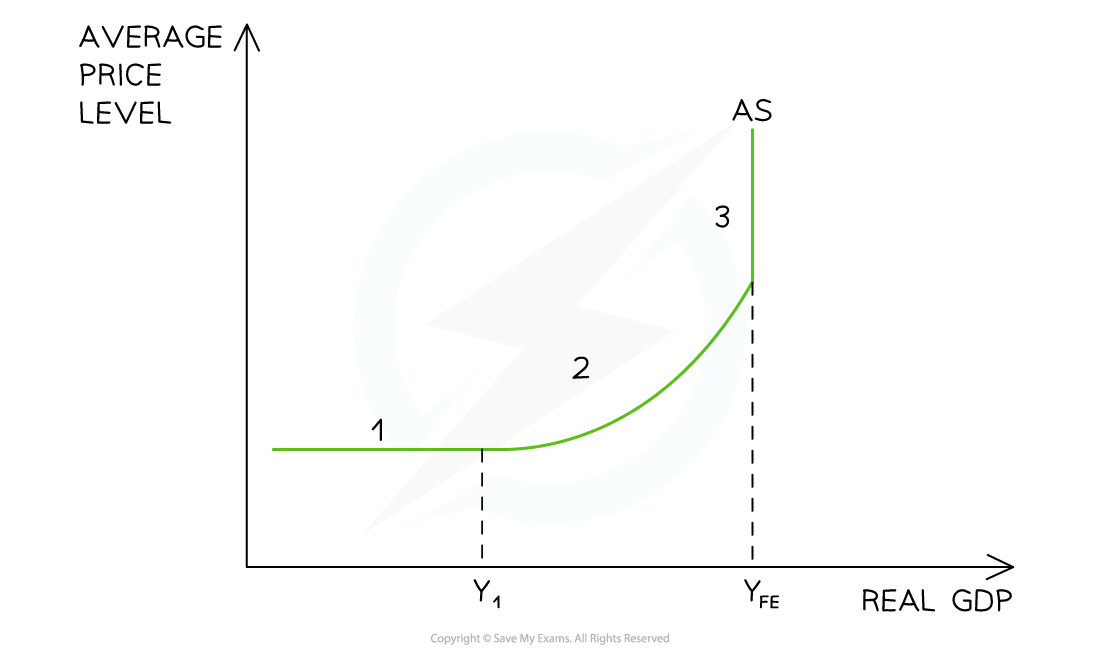
  • Keynes believed that the long-run aggregate supply curve (LRAS) was more L shaped, having 3 distinct sections 
  1. An elastic section in which supply is elastic at lower levels of output as there is a lot of spare production capacity in the economy. Struggling firms will increase output without raising prices
  2. A relatively price elastic section in which firms are starting to bid with each other for available resources. Price levels begin to rise
  3. A perfectly inelastic (vertical) section at a point of full employment (YFE) of all available resources. The closer the economy gets to this point the more price inflation will occur as firms compete for scarce resources
3-2-3-keynesian-view-of-as

 The Keynesian View of long-run aggregate supply (LRAS) with a vertical aggregate supply curve at the full employment level of output (YFE) becoming more elastic at lower levels of output
  

Diagram Analysis 

  • The vertical portion of the LRAS curve corresponds to the classical view of LRAS
    • The Keynesian view believes there is a maximum level of possible output
  • The LRAS curve becomes elastic at a certain price level as prices cannot fall further
    • Possibly due to minimum wage laws, the existence of trade unions, or long-term employment contracts preventing wage decreases
  • Real output national equilibrium can occur at any level of output

  • The Keynesian view believes that an economy will not always self-correct and return to the full employment level of output (YFE)
    • It can get stuck at an equilibrium well below the full employment level of output e.g. Great Depression
  • The Keynesian view believes that there is a role for the government to increase its expenditure so as to shift aggregate demand and change the confidence (animal spirits) in the economy

Inflationary & Deflationary Output Gaps

  • An output gap is the difference between the actual level of output (real GDP) and the maximum potential level of output
      
  • An inflationary output gap occurs when the real GDP is greater than the potential real GDP

  • A deflationary (recessionary) output gap occurs when the real GDP is less than the potential real GDP
    • There is spare capacity in the economy to produce more goods/services that are being produced
       
  • It is difficult to measure output gaps accurately
    • This is because it is hard to know exactly what the maximum productive potential of an economy is
    • Rapidly rising prices can indicate a positive gap is developing
    • Rising unemployment and slowdown in economic growth can indicate that a negative gap is increasing

A deflationary (recessionary) output gap

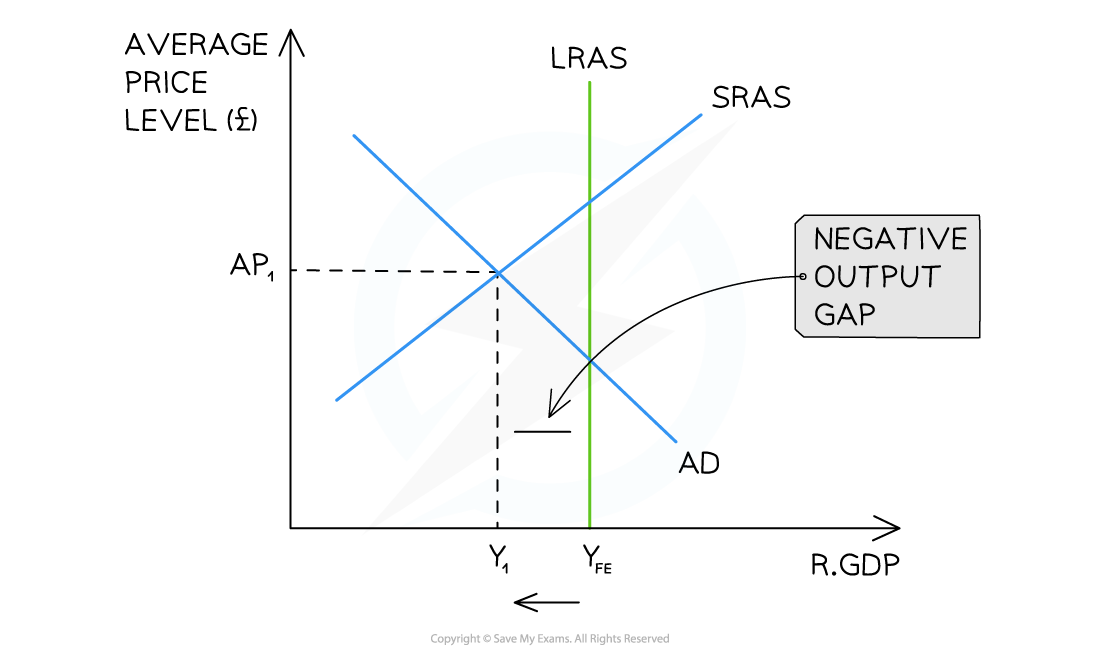
  • A deflationary gap can be illustrated using either a Classical or Keynesian diagram

3-2-3---deflationary-gap

2-5-2-negative-output-gap_2

Keynesian (top) and Classical (bottom) diagrams illustrating an economy that has a deflationary output gap (Y1- YFE) and is currently producing less than its potential output
 

Diagram Analysis

  • The potential output of this economy is at YFE
  • The economy is in a short-run equilibrium at AP1Y1
    • A negative output gap exists at  YFE - Y1
      • This effectively gives the economy additional spare capacity in the short-term
    • One cause of this may be that AD has recently decreased due to a fall in consumption
    • The Classical view is that the output will return to YFE  in the long-run, but at a lower average price level
    • The Keynesian view is that an economy may be stuck in a negative output gap for a long period of time


An inflationary output gap

  • An inflationary gap can be illustrated using either a Classical or Keynesian diagram
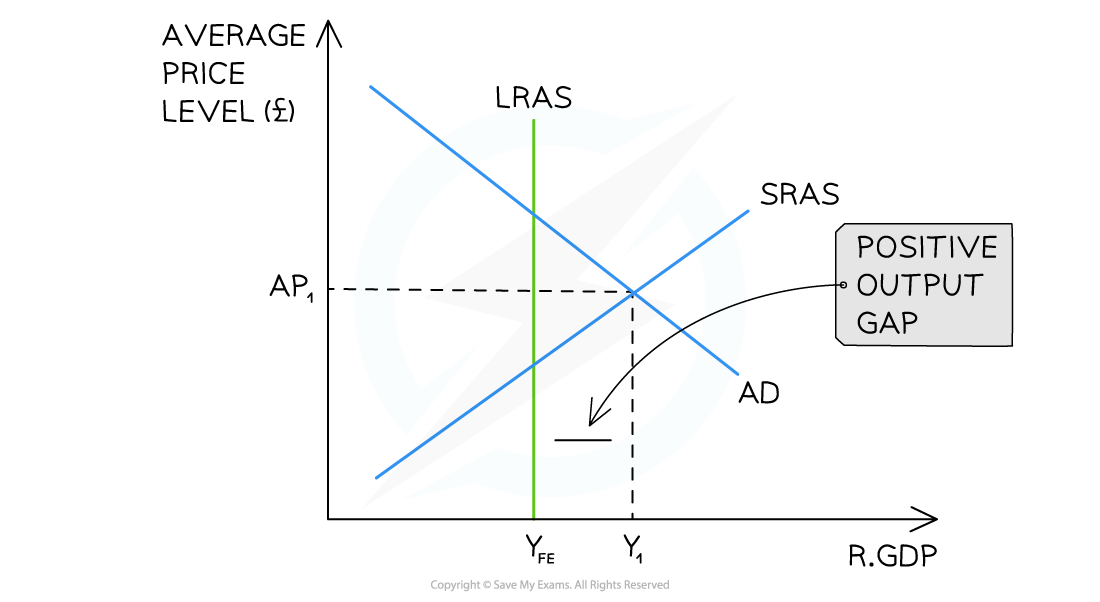
2-5-2---positive-output-gap

A Classical illustration of an inflationary output gap (Y1 - YFE) where the economy is currently producing more than its potential output
 

Diagram Analysis

  • The potential output of this economy is at YFE
  • The economy is in a short-run equilibrium at AP1Y1
    • A positive output gap exists at Y1 - YFE
      • This economy is producing beyond its capacity in the short-term
    • One cause of this may be that workers are willing to work overtime once full capacity is reached
      • It is not sustainable and the Classical view is that the output will return to YFE, but at a higher price level

Exam Tip

When writing about an inflationary output gap, students often confuse it with the concept of inflation (an increase in the average price level). Output gaps focus on output, not price levels. An inflationary output gap means that the economy is producing beyond its full employment level of output.



  • 1. Introduction To Economics
    • 1.1 What Is Economics?
      • 1.1.1 Economics as a Social Science
        • 1.1.2 The Problem of Choice
          • 1.1.3 The Production Possibilities Curve Model (PPC)
            • 1.1.4 Modelling the Economy
            • 1.2 How Do Economists Approach The World?
              • 1.2.1 Economic Methodology
                • 1.2.2 Economic Thought
              • 2. Microeconomics
                • 2.1 Demand
                  • 2.1.1 Demand, Price & Quantity
                    • 2.1.2 Non-Price Determinants of Demand
                    • 2.2 Supply
                      • 2.2.1 Supply, Price & Quantity
                        • 2.2.2 Non-Price Determinants of Supply
                        • 2.3 Competitive Market Equilibrium
                          • 2.3.1 Market Equilibrium & Disequilibrium
                            • 2.3.2 Functions of the Price Mechanism
                              • 2.3.3 Consumer & Producer Surplus
                              • 2.4 Price Elasticity of Demand (PED)
                                • 2.4.1 Definition, Calculation & Determinants of PED
                                  • 2.4.2 The Significance of PED
                                  • 2.5 Income Elasticity of Demand (YED)
                                    • 2.5.1 Definition, Calculation & Illustration of YED
                                    • 2.6 Price Elasticity of Supply (PES)
                                      • 2.6.1 Definition, Calculation & Determinants of PES
                                      • 2.7 Role of Government In Microeconomics
                                        • 2.7.1 Reasons For Government Intervention In Markets
                                          • 2.7.2 Government Intervention: Indirect Taxes & Subsidies
                                            • 2.7.3 Government Intervention: Price Controls, Direct Provision & Regulation
                                            • 2.8 Market Failure: Externalities & Common Pool (Access) Resources
                                              • 2.8.1 Market Failure
                                                • 2.8.2 Negative Externalities
                                                  • 2.8.3 Positive Externalities
                                                    • 2.8.4 Common Pool (Access) Resources
                                                      • 2.8.5 Government Intervention to Address the Market Failure
                                                        • 2.8.6 Other Interventions to Address the Market Failure
                                                        • 2.9 Market Failure: Public Goods
                                                          • 2.9.1 Public Goods
                                                        • 3. Macroeconomics
                                                          • 3.1 Measuring Economic Activity
                                                            • 3.1.1 National Income & The Circular Flow of Income
                                                              • 3.1.2 National Income Terminology & Calculations
                                                                • 3.1.3 The Business Cycle
                                                                  • 3.1.4 Appropriateness of Using GDP/GNI to Measure Well-being
                                                                    • 3.1.5 Alternative Measures of Well-Being
                                                                    • 3.2 Variations in Economic Activity (AD & AS)
                                                                      • 3.2.1 Aggregate Demand (AD)
                                                                        • 3.2.2 Short-Run Aggregate Supply (SRAS)
                                                                          • 3.2.3 Alternative Views of Aggregate Supply (AS)
                                                                            • 3.2.4 Shifts of the Long-Run Aggregate Supply (LRAS)
                                                                              • 3.2.5 Macroeconomic Equilibrium
                                                                              • 3.3 Macroeconomic Objectives
                                                                                • 3.3.1 An Introduction to Macroeconomic Objectives
                                                                                  • 3.3.2 Economic Growth
                                                                                    • 3.3.3 Low Unemployment
                                                                                      • 3.3.4 Low & Stable Rate of Inflation
                                                                                        • 3.3.5 Potential Conflicts Between Macroeconomic Objectives
                                                                                        • 3.4 Inequality & Poverty
                                                                                          • 3.4.1 Measuring Inequality & Poverty
                                                                                            • 3.4.2 Causes of Inequality & Poverty
                                                                                              • 3.4.3 Using Taxation to Reduce Inequality & Poverty
                                                                                                • 3.4.4 Other Policies to Reduce Inequality & Poverty
                                                                                                • 3.5 Demand Management: Monetary Policy
                                                                                                  • 3.5.1 An Overview of Monetary Policy
                                                                                                  • 3.6 Demand Management: Fiscal Policy
                                                                                                    • 3.6.1 An Overview of Fiscal Policy
                                                                                                    • 3.7 Supply-Side Policies
                                                                                                      • 3.7.1 An Overview of Supply-Side Policies
                                                                                                        • 3.7.2 The Effectiveness of Supply-Side Policies
                                                                                                      • 4. The Global Economy
                                                                                                        • 4.1 Benefits of International Trade
                                                                                                          • 4.1.1 The Advantages of Free Trade
                                                                                                          • 4.2 Types of Trade Protection
                                                                                                            • 4.2.1 Tariffs
                                                                                                              • 4.2.2 Quotas
                                                                                                                • 4.2.3 Export Subsidies
                                                                                                                  • 4.2.4 Administrative Barriers
                                                                                                                  • 4.3 Arguments For & Against Trade Protection
                                                                                                                    • 4.3.1 Arguments For & Against Trade Protection
                                                                                                                    • 4.4 Economic Integration
                                                                                                                      • 4.4.1 Understanding Economic Integration
                                                                                                                        • 4.4.2 Types of Trading Blocs
                                                                                                                          • 4.4.3 The World Trade Organisation (WTO)
                                                                                                                          • 4.5 Exchange Rates
                                                                                                                            • 4.5.1 Types of Exchange Rate Systems
                                                                                                                              • 4.5.2 Causes & Consequences of Exchange Rate Fluctuations
                                                                                                                              • 4.6 Balance of Payments
                                                                                                                                • 4.6.1 Components of the Balance of Payments
                                                                                                                                • 4.7 Sustainable Development
                                                                                                                                  • 4.7.1 The Sustainable Development Goals
                                                                                                                                  • 4.8 Measuring Economic Development
                                                                                                                                    • 4.8.1 Single Indicators of Development
                                                                                                                                      • 4.8.2 Composite Indicators of Development
                                                                                                                                        • 4.8.3 Evaluating the Different Approaches
                                                                                                                                        • 4.9 Barriers to Economic Growth & Development
                                                                                                                                          • 4.9.1 Poverty Traps
                                                                                                                                            • 4.9.2 Economic, Political & Social Barriers
                                                                                                                                            • 4.10 Economic Growth & Development Strategies
                                                                                                                                              • 4.10.1 Trade Strategies, Diversification & Social Enterprise
                                                                                                                                                • 4.10.2 Market-Based & Interventionist Policies
                                                                                                                                                  • 4.10.3 Merit Goods & Inward Foreign Direct Investment
                                                                                                                                                    • 4.10.4 Foreign Aid & Development Assistance
                                                                                                                                                      • 4.10.5 Institutional Change
                                                                                                                                                        • 4.10.6 Evaluating Market Orientated Approaches Versus Government Intervention
                                                                                                                                                          • 4.10.7 Progress Towards Sustainable Development Goals

                                                                                                                                                        Author: Steve


                                                                                                                                                        Save My Exams Logo
                                                                                                                                                        Resources
                                                                                                                                                        Home Join Support

                                                                                                                                                        Members
                                                                                                                                                        Members Home Account Logout

                                                                                                                                                        Company
                                                                                                                                                        About Us Contact Us Jobs Terms Privacy Facebook Twitter

                                                                                                                                                        Quick Links
                                                                                                                                                        GCSE Revision Notes IGCSE Revision Notes A Level Revision Notes Biology Chemistry Physics Maths 2022 Advance Information

                                                                                                                                                         
                                                                                                                                                        © IB Documents (2) Team & u/aimlesskr
                                                                                                                                                        IBO was not involved in the production of, and does not endorse, the resources created by Save My Exams.